Every December I take some time to go through my reading list for the year and reflect on it a bit. While I read primarily for pleasure and at whim, it is also one of the primary ways I learn and continue in personal formation. I find it an invaluable exercise to take stock of the year and also clarify some things as I think about my reading for the coming year.
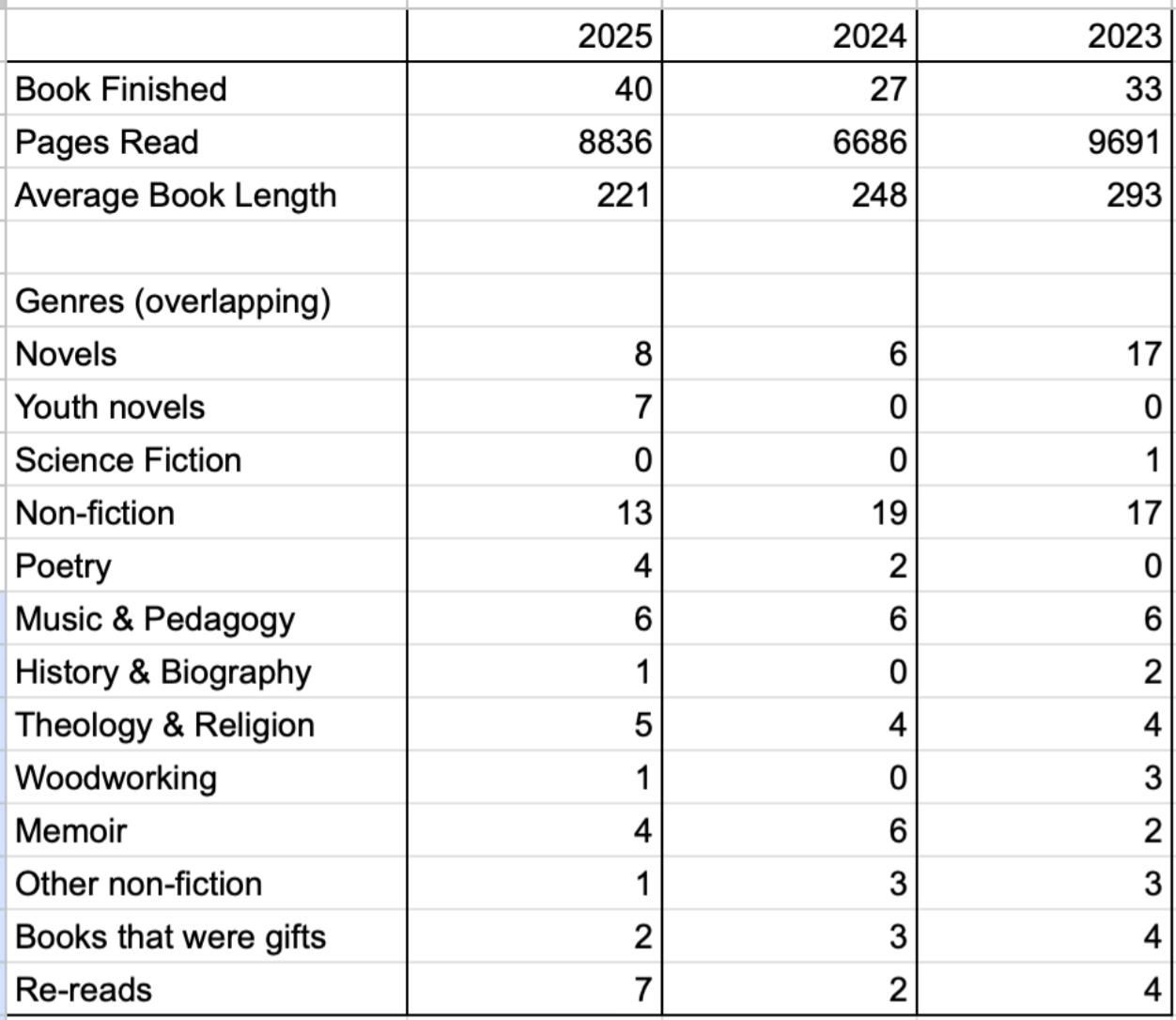
Two years ago I started writing a short annotation for each book when compiling my list, which is even better for thinking about a book you may have finished several months ago. I also do a little data crunching (at the bottom), which is just for my own enjoyment. Reading is not a competitive sport, though these numbers do help me understand how much fun I’m having.
Here are the books I finished in 2025 listed in chronological order by date of completion, with annotations:
Watch for the Light: Readings for Advent and Christmas, Various
- Edited by the good folks at Plough, this was a nice compilation of readings from a variety of sources.
Motherhood: A Confession, Natalie Carnes
- In a moment of serendipity, I picked this up right after finishing a slow read of St. Augustine’s Confessions not knowing that she was glossing his work through her perspective as a scholar and mother. Insightful and deeply personal.
Handel: His Life and Works, Jonathan Keates
- This was a “disambiguation” read, by which I mean, I was frustrated with the common stories and myths that circulate about Handel and the composition of Messiah seemingly every Christmas season so I finally went to a good source to sort out truth from fiction. Turns out, Handel regularly composed large-scale works in a matter of a few weeks (just like he did with Messiah), and other than obligatory participation in English civic religion he doesn’t seem to have been particularly devout. In fact, he seems to have been quite a man of the world.
- Great read though, and introduced me to much of Handel’s music that is just wonderful but not well-known.
Practicing Music by Design, Christopher Berg
- This is the best book of its kind that I know of (and there is a lot of tripe out there in the music practicing world). Combining insights from brain scientists with tested advice from great performers of the past, Mr. Berg (who, in full disclosure, was my guitar teacher for my undergrad years) gives a set of practicing tools that increase the learning value of practice immensely. I give a lecture in my freshman musicianship class summarizing the ideas of this book and it makes a huge impact on my students. If you have anything you practice regularly (an instrument, chess, a sport, anything) and would like to improve there are insights in this book that will help you.
Ambition Monster, Jennifer Romolini
- From one of my favorite sub-genres of “trying to make it in publishing in the big city in the early aughts,” this is quite a tale. It’s one of those memoirs that one suspects has been somewhat burnished (let’s avoid accusations of fabulism) into the punchy narrative it is, but it’s terrifically fun nonetheless.
Zero at the Bone, Christian Wiman
- One of the things I get from Wiman’s prose is exposure to poems (his and others). This work got me on to Wallace Stevens which filled a lot of the poetry reading I did this year. I appreciate his voice, but I am often frustrated by his ability to doubt everything except his own modern sensibility. Despite that, some incredible writing throughout this volume.
The Marriage You Want, Sheila Wray Gregoire, Keith Gregoire
- I read this along with a young couple my wife and I have been meeting with pre-engagement. I have what I consider a very good marriage, which I account largely to our ability to ignore most of the marriage advice found in christian literature on the topic. This book is not one to ignore, but includes a lot of helpful framing and information, and is one of the few that doesn’t fall into the unhelpful gender stereotypes that make up most books of this kind.
Charlie and the Chocolate Factory, Roald Dahl
- One of the great upgrades to my reading life this year is that my oldest (he turned 5 in June) is up for reading “chapter books” at bedtime instead of just children’s books. I’ve taken this opportunity to revisit some of my childhood favorites and it’s been a gas. We started with the master of the form: Roald Dahl. I absolutely loved his books as a child, and I enjoy them even more as an adult (as does E). Dahl said that writing children’s books was much harder than writing regular literature, because adults read a book once and are done with it. Children, however, will read a book again and again and it has to be able to hold up to their imagination over and over. It was both stranger and more fun than I remembered.
In the Name of Jesus: Thoughts on Christian Leadership, Henri Nouwen
- I read with a small group of men from church. Nouwen describes his decision to leave a successful career in academia to serve in a group home for adults. By “Christian leadership” he of course means Christ-like service, one of the few books (and lives) I’ve ever read that actually follows that thought to its logical conclusions. Challenging and convicting, we had wonderful discussions about work, faith, parenting, and more in our group.
Mr. Popper’s Penguins, Richard and Florence Atwater
- Another bedtime read with my son. He absolutely loved this one, and it was much different than I remembered it from reading it 25 years ago or so.
Hallowed Be This House, Thomas Howard
- This was recommended to me by someone after a discussion of viewing the world sacramentally. I thought I would enjoy it more than I did, but it was fine.
My Name is Red, Orhan Pomuk
- After a non-fiction heavy start to the year, I got in the mood for some novels. This was a re-read, though it has been 8 or 10 years since the first time I read it. It is an astounding work with depth and detail that is hard to believe. Told exclusively in first person narrative by every character (and some animals, paintings, and others objects), on its face it is a murder-mystery about 16th century ottoman manuscript illuminators and miniaturists. But like all great murder-mysteries, it is probing many deep questions. East and West, Islam and Christianity, iconoclasm and iconography, writing and painting, love and lust, looking and seeing.
- I was introduced to this book by a piece of guitar music written by my friend Ron Pearl. I’m pretty sure this is the only time that has happened.
The Noise of Time, Julian Barnes
- A historical novel about one of my favorite composers, Dmitri Shostakovich. I’ve read a number of biographies about Shostakovich and listened to hours of his music. In this attempt at interiority by Barnes I didn’t meet the person I imagine Shostakovich to have been, though there were some effective ideas. I also found his writing a bit…twee? The kind of thing that passes for good writing but is actually not that great.
Americanah, Chimamanda Ngochi Adiche
- Another great novel. This was much of what you hope a modern novel to be: deep characterization, overlapping timelines and settings, cultural clashes. Very enjoyable, if a bit on the long side.
Harmonium, Wallace Stevens
- I have read a Stevens poem here or there for years, but Christian Wiman’s treatment of several of his poems in Zero to the Bone encouraged me to finally pick up this collection. I learned a lot about modern poetry reading this. His poems have the rare quality of being enjoyable even when inscrutable. Stevens is to poetry what Charles Ives is to music. And both happened to work in insurance, which is just the kind of trivia I love.
All the Beauty in the World, Christopher Brinkley
- This was gifted to me by a friend when I mentioned I would be visiting the Metropolitan Museum of Art this summer. It is the memoir of a man who, wracked with grief after the death of his brother, quit an enviable corporate publishing job to work as a guard in the Met for ten years. Brinkley concluded that standing quietly among the world’s greatest art would be what he needed to heal, and he was right. Enjoyable on so many levels, absolutely recommend. Especially good for museum and art lovers.
Between Two Sounds: Arvo Pärt’s Journey To His Musical Language, Joonas Sildre
- This was the first graphic novel I ever read cover-to-cover. Likely the last. My attention is just not calibrated to enjoy this, though I understand why others would.
Charlotte’s Web, E.B. White
- When it comes to children’s literature I am a firm believer that you stick to the classics. Surprisingly, a lot of classic children’s books are mostly about death. Charlotte’s Web really takes an unflinching view of the facts of life, but through the appropriate vehicle of farm life. This theme returned later in the year.
Alice’s Adventures in Wonderland, Lewis Caroll
- Another read with E. Even weirder than you remember it being! Some truly hysterical dialogue (I was cackling while reading the tea party scene out loud).
How to Know a Person, David Brooks
- Maybe not a book I would have picked up on my own, but it was given to me (perhaps a subtle hint?) and I enjoyed reading it. My main criticism is that I think it’s very unlikely that a book about conversation skills can effectively teach conversation skills in any practical way.
The Classical Style: Haydn, Mozart, Beethoven, Charles Rosen
- A magisterial work of criticism and analysis. Rosen’s depth of knowledge of this repertoire is truly astounding. To become capable of writing a book like this requires daily in-depth study for decades. I’ve already been surprised how much I’ve used his ideas in my own teaching.
Stuart Little, E.B. White
- Such a strange and effective little book. White’s ability to turn a sentence is wonderful for the reader, and the audacity of the book’s premise was not lost on E. Stuart (who is a mouse) is also a fully accepted member of the family and they make various accommodations for him. But not so much that he doesn’t occasionally get stuck in the blinds and nearly die.
Fig Pudding, Ralph Fletcher
- I didn’t read this as a child, but my wife remembered it and picked it up at a thrift store. It’s about a family of 6 kids, five brothers and a sister (exactly like my family growing up, so that got my attention). I won’t spoil it, but let’s just say some very heavy things happened for a children’s book. Death is a major part of this book, but unlike Charlotte’s Web it doesn’t remain with the animals. When E’s betta fish, Mikey, his first pet, died in November I was reminded of how important it is to encounter difficult things in art before you encounter them in real life.
Arvo Pärt: Sounding the Sacred, ed. Peter Bouteneff
- This is a collection of analytical and critical essays from the perspective of sound studies, which has been making its way to more concert music from its origins in jazz and pop music. I think it’s generally the wrong tool for the job, and most of the essays were not particularly insightful. Most of the authors have some other interest that they were attempting to cudgel Pärt’s music with but it didn’t result in good analysis. Pärt is one of my favorite composers, so it was a bit disappointing.
- One interesting tidbit was that Pärt worked for quite a while as a sound engineer and radio operator. When he started working with Manfred Eicher at ECM records to record the standard versions of his works, his understanding of recording and making a particular sound was clearly a factor in achieving such a consistent “Pärt sound.” His monk-like persona hides some signifiant technical prowess.
Hamnet, Maggie O’Farrell
- My wife is a prolific reader of novels, most of which are not exactly my taste, but when she recommends a book to me I almost always read it (she does tend to know what I like). This was an excellent recommendation (and before I knew there was a Chloe Zhao film version in the works). It was a bit of a slow start, but the second half was riveting. O’Farrel’s realism and unflinching depiction are wrenching. Great, great ending as well.
- We went to see the film in the theater in December. Beautifully made, and just as wrenching as the book. There was loud and open weeping throughout the theater (which, on the rare occasions I darken a movie theater, is exactly what I want). Book and film both highly recommended.
Their Eyes Were Watching God, Zora Neale Hurston
- I didn’t read a ton of novels this year, but man, I chose some good ones. I also read quite a few first-for-me authors, including Hurston. Her novels were an extension of her anthropological work with American Blacks while slavery was a living memory and Jim Crow daily life. Her ability to create vivid and realistic characters through dialogue is really amazing. This book is like sitting on the stoop while friends and neighbors pass through telling tales.
King Lear, William Shakespeare
- I read this before seeing it on stage, and was reminded yet again of the incredible work actors and directors do. Much better on stage than page, but his sheer imagination is always startling.
A Field Guide to Getting Lost, Rebecca Solnit
- This is one of those wonderful, broody collections of essays that are so beautifully wrought you just float through enjoying the sentences and images. Would be a perfect companion to a long road trip through the American west.
The Bluest Eye, Toni Morrison
- Another great novel, but absolutely harrowing. Themes of trauma (committed, experienced, inherited, cultural) self-image/hatred, and the colonization of the mind. Morrison does not flinch in her portrayal, with almost journalistic precision, of the facts this story builds over the course of the book. Morrison’s first published work, it took some time to gain attention and won the Nobel prize in 1993, 23 years after publication.
The Big Relief, David Zahl
- Another read with a small group of men from church. Led to a lot of good discussions, Zahl is a great collector of good illustrations.
Sharpen This, Christopher Schwarz
- An essential guidebook for anyone who works with sharp tools and needs to know how to make them sharp again. “Making tools dull is more fun than making them sharp.” “The solution to nearly every woodworking problem is sharp.” Schwarz is a delightful writer, and the instructions in this book are a model of clear instructional writing with comic relief.
Ralph S. Mouse, Beverly Clearly
- Another read with E. He got very invested in the mouse show the class put on.
The Nine Tailors, Dorothy L. Sayers
- Yet another first, my first Dorothy Sayers book. This one was chosen somewhat at random (I found a nice hardbound copy at a book sale) but it was very enjoyable. It is a bit of a slow opening with a lot of campanology (bells and bell ringing), but they were sufficiently integrated into the plot it made sense structurally by the end.
The Liberated Imagination, Leland Ryken
- Ryken outlines a very coherent set of principles around engaging in the arts. A lot here I had worked out in my own thinking and teaching, but some nice new additions as well. Its real weakness is his one-dimensional portrayal of modern art and its various movements. He just doesn’t have a broad enough experience with it to comment helpfully on it as a whole, which is what he purports to do.
The Sonnets of William Shakespeare, William Shakespeare
- Something of a bucket list check-off, but thoroughly enjoyable as well. Such a wild imagination. Take a few months and read one a day, you’ll be better for it. If nothing else, you can be one of those smug folks who casually mentions you’ve read all of Shakespeare’s sonnets (caveat lector).
Entries, Wendell Berry
- This collection from 1994 was a real treat. Berry is somewhat uneven as a poet. I found this out reading sections of the New Collected Poems. It’s a bit of a scavenge. I’ve also learned that I much prefer smaller, curated collections of poems anyway. Nice small books you can put in your jacket pocket on a walk, just in case.
- The collection is divided into four sections. Section 1 is Berry at his ruminative and grateful primarily, seeking a peaceful alternative life. Section 2 wanders toward his angsty register frequently. Section 3 ranges into issues of love and loss, male and femaleness, and the various connections we make throughout our lives and how they change.
- The final section, In extremis: poems for my father is the highlight of the book. Written (autobiographically, I assume) from the perspective of a middle-aged man caring for his aging father, they are elegiac, tender, frustrated, and bracingly honest about the challenges of aging and caring for an aging parent. The lessons learned from a father, the memories of ancestors slipping away from his slowing mind, the depredations of a mind and body once strong and capable (”His mind was then an act / Accomplished soon as thought, / Though now his body serves / Unwillingly at best / His mind’s unresting will.”), the frustrations of disagreements, and the memories of past hurts all swirl together, connected by the clear love for the father that doesn’t hide away his faults and challenging personality. Some of the most moving of Berry’s poetry I have read, I’m sure I will return to this in the future.
Small Teaching, James L. Lang
- I started reading this on a Sunday and used an exercise in class Tuesday. Immensely useful and practicable. Much like musical performance, a lot happens in the moments and this book is about teaching the moments. Highly recommend to anyone who wants to teach things to other people and have them learn.
- Lots of overlap with the reading I’ve done on practicing instruments. What do you know, learning is roughly the same whatever your discipline. A project I would love to tackle is writing/adapting a set of small teaching strategies for one-on-one music lessons. There is much opportunity to apply these there, but a little adaptation might be needed. Plus, there is a general dearth of good literature about teaching applied lessons rather than in a classroom setting.
The Strange Case of Dr. Jekyll and Mr. Hyde, Robert Louis Stevenson
- Needed something quick to tide me over while I waited for a book in the mail. Found this on the shelf and it was great fun. Hadn’t read it since I was probably 13 or 14. RLS likes his long sentences, but it’s a very short book. Perhaps literature’s most influential novella? I can’t think of another with cultural recognition like this one.
A Christmas Carol, Charles Dickens
- I have seen this on stage and listened to various audio versions nearly every year of my life, but to the best of my recollection I have never actually read this book myself. An error corrected! I started it with E and he was a real trooper, but he was afraid of the ghosts (he’s a sensitive soul) so I finished it on my own. I’ve never gotten into any of the long Dickens novels (though I love the good miniseries versions of them), I just may have to in the coming year.
Waiting on the Word, Malcolm Guite
- Guite is one of my guiding lights and I returned to this wonderfully curated collection of poems for Advent, Christmas, and Epiphany (I read ahead a bit…). Reading analysis of poems can be like reading a dishwasher manual, but Guite’s is vivid and full of insight. Particularly where broader prior reading than my own is useful he always sheds light without getting in the way.
And now, the numbers. A single book can be counted for more than one genre, so those numbers do not add up to the total at the top. I find those categories helpful to see what kinds of things I’m reading in broad strokes. I also have data from the last two years. Turns out I had quite a good reading year (2023 numbers are artificially boosted by the birth of my twins, I spent most nights that year feeding a baby and reading).