That’s right, it’s Christmas break and we’re reviewing sixty year old recordings.
When it comes to baroque music, I’ve usually been a fan of small ball. Bach cantatas with a chorus of 16 is usually right, and a nimble chamber orchestra is all they need. The music is acrobatic and large ensembles often can’t maneuver at the pace needed.
The same goes for Handel’s Messiah. The recording I have listened to the most is the Academy of Ancient Music directed by Christopher Hogwood. Another particular favorite is Stephen Cleobury’s, which takes all of part I like it’s single breath. Really thrilling pacing.
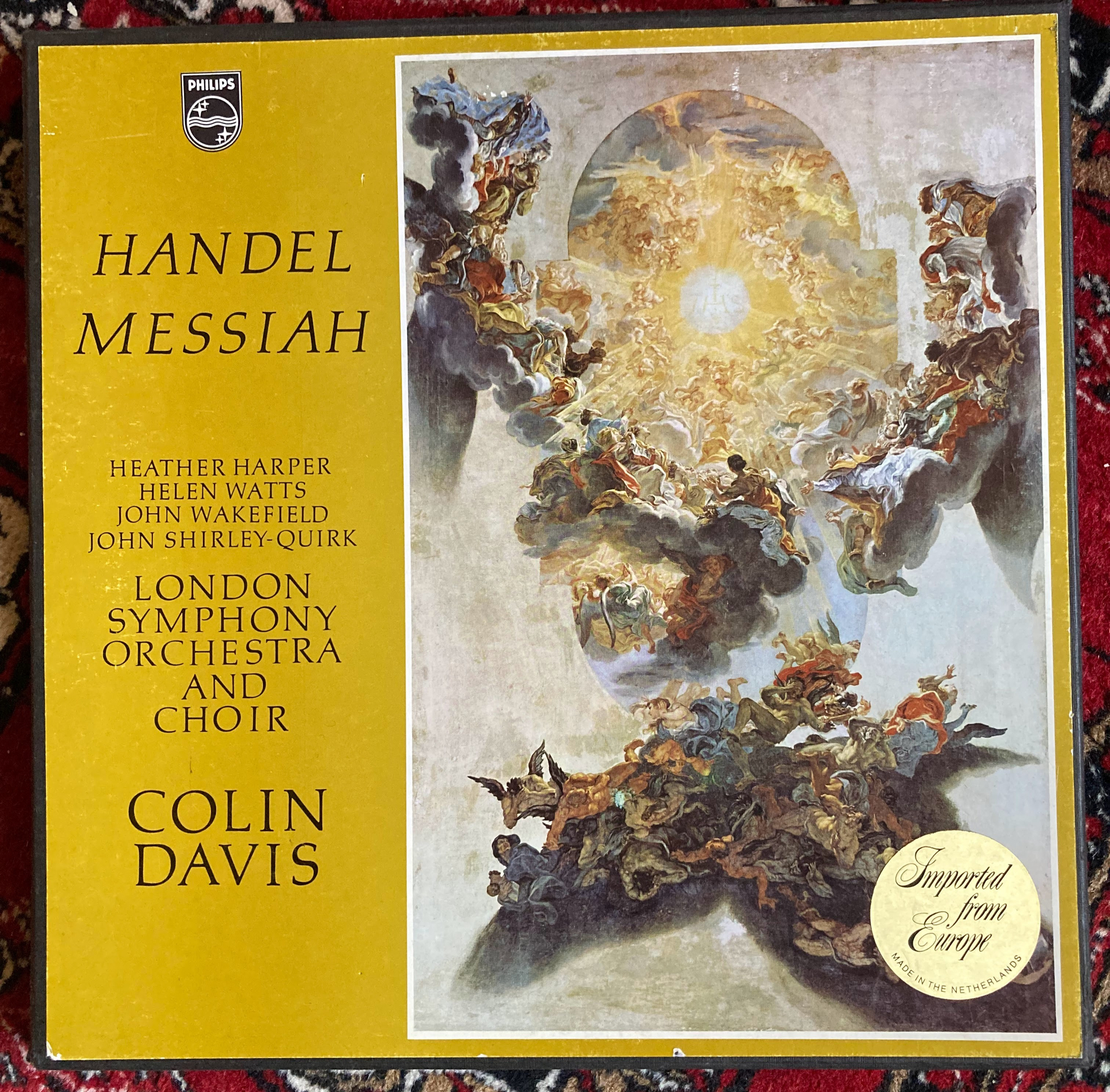
This year though, I decided to listen through the 1966 London Symphony recording directed by Colin Davis. I’ve had it on vinyl for years (before I had a record player I think, a thrift store find) but realized I’d never actually listened to it. I expected not to like it very much, since it is firmly from the “Big Bach” era of baroque recordings with romantic sized orchestras.
I was wrong, it is wonderful. Though skeptical, I was won over by the end of the Sinfonia. The opening section seemed lethargic to my tastes (24 violins can’t be quite as overdotted as 3), but the heft it gives to the fugatta section was striking. This was the impression throughout, bigger bigs but still small smalls. This group can get to real size without straining.
The tempos are not ponderous, even though the forces are large. The chorus is also quite nimble. It’s hard to imagine the Berlin Philharmonic chorus of the same era handling the choral fugues with the clarity achieved here, but the English choral tradition of a straighter tone and precise tuning really helps.
John Shirley-Quirk is another highlight. His musicianship is unmatched, and his sense of sung English (highlighted in his work with Britten’s operas) is magnificent. The rest of the soloists I could take or leave, Wakefield particularly is the wrong fach.
You may have attended a performance of Messiah that ended with the Hallelujah Chorus. I have. And I would like to apologize for the artistic crime committed against you. The Hallelujah Chorus is a little mid-concert diversion compared to the real ending (and highlight) of Messiah: “Worthy is the Lamb who was slain.”
This is not just the highlight of the work, in context it is the greatest thirty seconds of music in the Western canon. The most perfect unity of form and content ever achieved (despite what Kierkegaard might say about Don Giovanni, music is primarily transcendent, not erotic). When I have sung in the chorus I usually haven’t gotten a single note past the lump in my throat from this point on. Sorry, fellow tenor 2s.
Davis delivers this through the Amens perfectly. Just the right pacing and weight, and truly shimmering violins on the instrument fugue that interrupts the amens before the final chorus.
Davis has another recording of this work with LSO from 2006. Perhaps that will be next.