After the explanation and introduction, on to the albums:
The influence my older brothers had (I have three of them 4-, 11-, and 15-years older) on my musical tastes cannot be overstated (we did our best on the youngest but I understand he mostly listens to lo-fi beats and dubstep [this is a joke {mostly}]). What thirteen-year-old is banging away to Philip Glass’s North Star or sitting through the long version of Gavin Bryars’s Jesus Blood Never Failed Me Yet? You don’t find these things on your own, especially when you don’t have internet access and you’re still looking for Great Illustrated Classics on visits to the library.
A lesson I learned from them early on is that interesting music tends to be found in a few reliable places. Nonesuch, ECM New Series, Argo, and Bis were the labels to look for. Another of these trusted sources is the Kronos Quartet. A Kronos record will always be interesting, some will change your life.
Much of the great quartet music of the last fifty years is thanks to their commissioning work, and the three string quartets of the Polish composer Henryk Gorecki are no exception. Of the many Kronos recordings I adore, String Quartet No.3 “…songs are sung” is probably my favorite. I listened to over and over again after it was released in 2005.
Gorecki’s career follows a trajectory somewhat common for composers born in the early 20th century. An upbringing in formal music education meant an expectation of learning and composing serialism. Once established he turned toward a quasi-tonal style influenced by pre-classical music. This later style (and his return to writing liturgical works) means he is often compared to Arvo Pärt and John Tavener, but his style is his own.
Though his career follows a familiar trajectory, it has one unusual characteristic: a massive hit recording with his Symphony No. 3. It has sold over a million copies, a ridiculous number for a contemporary classical CD. Remarkably, his composing style does not seem to have responded to fame and that remains his only widely known work. (My own first encounter with Symphony 3 work was on a trip to Phoenix of all places. I bought a used copy in a book & record shop. Back at the hotel that night I synced it to my iPod and listened to it straight through lying on the floor of the hotel room while everyone else was asleep).
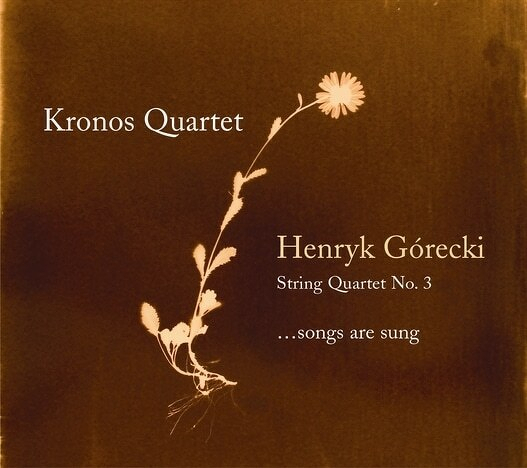
All three quartets are works of melancholy, and even anguish, but very different projects structurally. The first is a single long movement following the model of Shostakovich’s 13th. The second is a four movement classical quartet in a highly dissonant sonority. The third (Op. 69) is on a massive scale lasting almost 50 minutes. Of its five movements only the third is at a faster tempo (and not that fast). The other four are slow, dissonant, mournful but not harsh, and with a distinct progression toward hopefulness in the last two movements.
The quartet (following an innovation of Bartok) is in a symmetrical arch form. Symmetry and balance are the preoccupying structural features. The four slow movements are each almost exactly ten minutes long, with the middle movement lasting five. Each movement has distinct sections that mirror one another. The central movement inverts the form of the work as a whole with a central slower section (introducing some of the first unambiguously major key material) surrounded by the agitated counterpoint of the outer sections. There’s something of a dialectic from minor key dissonance toward major key consonance broken by the activity of this middle movement. This large scale movement continues until the final chords which resolve with a flat 6 suspension reminding us of the minor key beginning of the piece before settling into a long, low-voiced major chord.
Kronos plays with a sustained intensity that never flags but also never overflows the banks of Gorecki’s introspective restraint. They are known for not over-polishing their sound with vibrato, and that effect gives a raw expressiveness to the melodies.
This is decidedly inward-focused music. It is a commitment, but repeated listenings reveal a work of psychological depth. It is one of many expressive touchstones I return to again and again.
If there is one lesson this album taught me, it is that music can go straight to your heart in a way nothing else can. A serious lesson to learn when you’re fourteen.