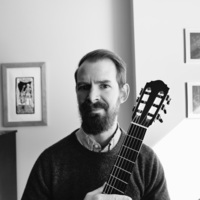
This is a program note I wrote for a few concerts I’m playing this month.
The way I see it, the most exciting thing about being a classical musician is participating in a tradition. Guitarists have five hundred years of lute and guitar repertoire to explore, enjoy, and perform. Maintaining this tradition has two responsibilities: preservation and progress. If we don’t compellingly present the worthy music of the past it will be lost. If we don’t promote new (sometimes uncomfortable) music, then our living tradition becomes a museum that will slowly but surely die. This program is an attempt to do both of those things and show some strains of continuity across five centuries of making music plucking strings.
The guitar is considered one of the most difficult instruments to compose for. Intricate polyphony is possible, but many simple chords are unplayable. Because of this, much music for the guitar (and lute before it) was written by performers who also composed. The first three composers on this program played the lute. Francesco, Dowland, and Weiss were each among the most famous musicians of their day, but with the passing of the lute as a major instrument their music fell into obscurity. In this sense Weiss, like his contemporary J. S. Bach, was as obsolete as he was famous by the end of his life.
The rest of the works are paired by genre but written at least two hundred years apart. Though of different eras and styles, the starting points of grief, nature, movement, and a formal process show through as these musicians living in different times and places picked up their instruments or sat down at their desks to compose.
To these works, and in this venerable tradition, I add two of my own. The title Lost Loss comes from a book I was reading when writing this. It describes the feeling of missing something but not knowing what that thing is (in this case, a secure sense of tonic for most of the piece). Fierce Friend (dearest friend) is related in material but uses a more dissonant harmonic language incorporating microtones. In an arch form (ABCBA) with coda, the central slow section is an exploration of the clash between twelve-tone equal temperament, just intonation, and the frets of the guitar. (That is far more technical than a program note should ever be, I apologize). The coda is a reimagining of the familiar chorale melody that inspired the title.
If you’re curious, you can hear the premier performance of my pieces here.