
“The only way to change the past is with the quality of attention you give to the present.”
- David Whyte
A year ago, in March 2025, after a fairly steady increase in time staring at my phone each day, I decided it was time to do something about it. The exact tipping point has escaped my memory. Most likely it was a combination of things that finally impelled me to make changes I knew I wanted.
What I wanted to do was obvious. I wanted to spend several hours per day fewer looking at my phone. Those hours I wanted to turn into paying better attention to my children, being more focused at work, reading books and periodicals, and generally being more present. Maybe thinking a stray thought now and then.
The why (I was spending too much time on my phone) and the how (to stop) were not as clear. I consider myself a reasonably mature and disciplined person. How was I accidentally spending several hours per day more than I said I wanted to starting at this stupid thing?
An honest answer to this question had to be made. There is some amount of difference between the person we like to think we are as and the person we actually are. The size of this gap varies person to person. You probably know someone with a very large gap and others with a smaller or gap. I did not think of myself as someone who looks at his phone for 4-5 hours a day. But I was, because I did. You are your habits.
I eventually figured out why. I had to come to terms with the fact that I was looking at the phone to cope. At that time, having not-quite-two-year-old twins was challenging (in a very normal sense, many people have much more challenging lives, but it was difficult nonetheless). It was simply much easier to look at the phone than to deal with two needy and often crying children. Or at least to disappear for a few minutes of pleasure after dealing with them. I would say coming to terms with this and facing it as a personal deficiency was the most important factor in this project.
More accurate self-knowledge being attained, I had a fifteen year habit to kick (first smart phone: 2013, iPod touch: 2010). If will power alone was going to work, it would have already done so. I was fairly sure a change in habits would require a change in equipment. I was ready to look for a dumb phone.
 If you’ve explored this you know that it gets overwhelming quickly. Lite phone, wise phone, the brick. All kinds of startups (and more all the time), most of them delivering what appear to be very unimpressive tech at purity-test pricing. I didn’t see myself spending ~$500 on a phone the purpose of which was to do fewer things and that only does those things when it’s in a good mood. I wanted the sturdy utilitarianism of my first flip phones with a few of the most useful tools of the smartphone. I needed a list. (That is the second Frog & Toad allusion for those keeping track.)
I came up with what seemed like a modest list:
If you’ve explored this you know that it gets overwhelming quickly. Lite phone, wise phone, the brick. All kinds of startups (and more all the time), most of them delivering what appear to be very unimpressive tech at purity-test pricing. I didn’t see myself spending ~$500 on a phone the purpose of which was to do fewer things and that only does those things when it’s in a good mood. I wanted the sturdy utilitarianism of my first flip phones with a few of the most useful tools of the smartphone. I needed a list. (That is the second Frog & Toad allusion for those keeping track.)
I came up with what seemed like a modest list: - Navigation
- I briefly considered a dedicated GPS, but Garmins are also expensive and appear to have made absolutely no UI progress since I last used one circa 2010. Oh, and most of their new features also require connection to a smartphone. I also navigate on foot and by bike occasionally. It needed to stay on the phone.
- Podcast app/music streaming
- I listen to podcasts and music daily. I usually listen to CDs in my car, but there are lots of times I want to have access to streaming media away from my car or computer.
- Bluetooth
- To connect to devices which play the podcasts and music.
- Calls, texts, and group texts (you know, a phone)
- If you have always been on iPhone you need to emotionally prepare for the violent reaction your iPhone friends will have when your texts now come through in green bubbles instead of proper blue bubbles. This is real.
I was willing to compromise on just about everything else, but these few things painted me into a surprisingly small corner. The number of phones offering actual navigation and streaming media without a large screen and everything else in the world is quite small.
This was all a bit of a non-starter, until I found Jose’s Dumbphone Finder. This tool allows you to select your nonnegotiable features then shows what phones are available. This brought me to what was quite literally the only option that met my criteria, the Tiq M5 Mini. I ordered one for $190 on eBay, which arrived broken. When its replacement came I switched my SIM card over and used this phone exclusively for the next 6 months (except for a ten day period when I was leading a study abroad trip in Europe and needed more firepower; for that I just swapped my SIM back to my old iPhone).
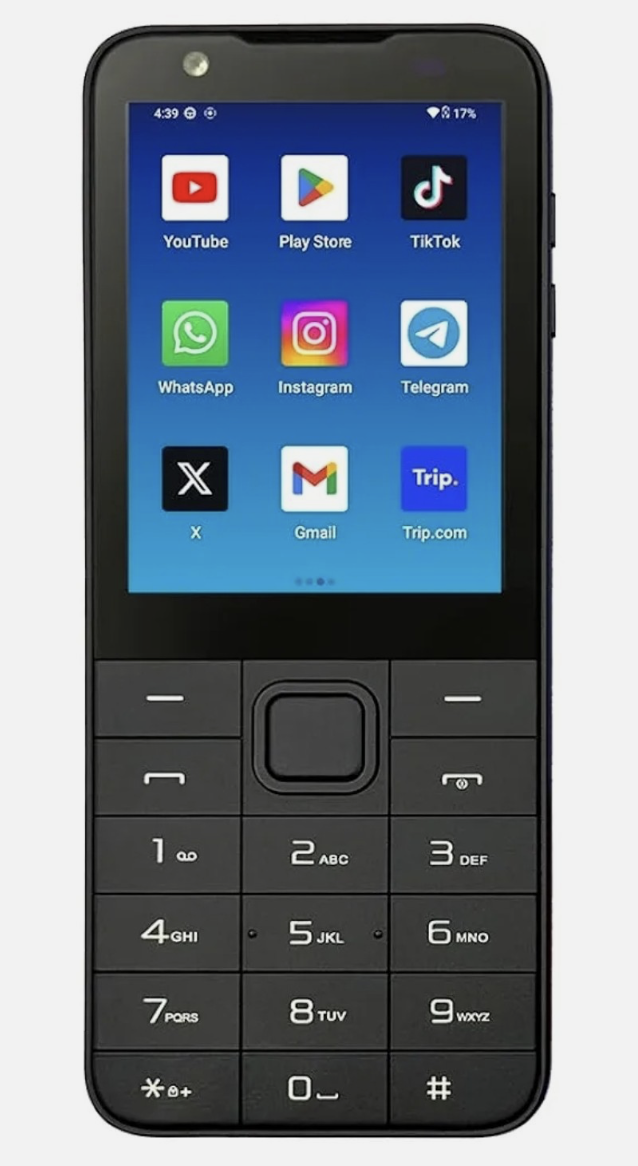 The M5 Mini is indeed a full-featured smartphone running Android, which I actually prefer to the well-dressed bully that is iOS. And along with the physical buttons it has a touch screen and supports voice-to-text, which is really the only way to do anything on this phone.
The thing is though, that screen. It’s tiny. It has terrible colors and a slow refresh rate. It really doesn’t draw you in. It was exactly what I was looking for.
It is a very mediocre piece of hardware. Slow, laggy, takes almost 5 minutes to boot up, don’t even think about multi-tasking. Unappealing and just barely able to get the job done, but priced accordingly. This is what you want to reset your brain. The friction wears down those pleasure receptors quickly.
The first few weeks I would impulsively reach for this silly little phone only to think “what am I going to do with that?” This was exactly what I was hoping to fix - the habitual reach. It was also a great conversation starter. Millennials were nostalgic; other dads at the park would rush over to ask me about it. Gen Zs were curious and slightly horrified. The physical buttons were a wonder to them. I showed some of my students how I could text with T9 and broke their brains. I felt like Jed Clampett.
I used this little guy for about six months. Then I dropped it in the toilet. It dried out and seems to still work, but while it was in the rice I switched back to the iPhone. And guess what? I’m ok. In fact, now that my itchy trigger finger was reformed, the iPhone helped me be on the phone even less since it was good at doing the few things I wanted it to do. No black and white screen, no parental controls, just fixing my own broken default attention.
Here is my five step guide to spending less time on your phone:
The M5 Mini is indeed a full-featured smartphone running Android, which I actually prefer to the well-dressed bully that is iOS. And along with the physical buttons it has a touch screen and supports voice-to-text, which is really the only way to do anything on this phone.
The thing is though, that screen. It’s tiny. It has terrible colors and a slow refresh rate. It really doesn’t draw you in. It was exactly what I was looking for.
It is a very mediocre piece of hardware. Slow, laggy, takes almost 5 minutes to boot up, don’t even think about multi-tasking. Unappealing and just barely able to get the job done, but priced accordingly. This is what you want to reset your brain. The friction wears down those pleasure receptors quickly.
The first few weeks I would impulsively reach for this silly little phone only to think “what am I going to do with that?” This was exactly what I was hoping to fix - the habitual reach. It was also a great conversation starter. Millennials were nostalgic; other dads at the park would rush over to ask me about it. Gen Zs were curious and slightly horrified. The physical buttons were a wonder to them. I showed some of my students how I could text with T9 and broke their brains. I felt like Jed Clampett.
I used this little guy for about six months. Then I dropped it in the toilet. It dried out and seems to still work, but while it was in the rice I switched back to the iPhone. And guess what? I’m ok. In fact, now that my itchy trigger finger was reformed, the iPhone helped me be on the phone even less since it was good at doing the few things I wanted it to do. No black and white screen, no parental controls, just fixing my own broken default attention.
Here is my five step guide to spending less time on your phone:
- If you have always been on iPhone you need to emotionally prepare for the violent reaction your iPhone friends will have when your texts now come through in green bubbles instead of proper blue bubbles. This is real.
I was willing to compromise on just about everything else, but these few things painted me into a surprisingly small corner. The number of phones offering actual navigation and streaming media without a large screen and everything else in the world is quite small.
This was all a bit of a non-starter, until I found Jose’s Dumbphone Finder. This tool allows you to select your nonnegotiable features then shows what phones are available. This brought me to what was quite literally the only option that met my criteria, the Tiq M5 Mini. I ordered one for $190 on eBay, which arrived broken. When its replacement came I switched my SIM card over and used this phone exclusively for the next 6 months (except for a ten day period when I was leading a study abroad trip in Europe and needed more firepower; for that I just swapped my SIM back to my old iPhone).
- Face yourself. 1. Say out loud or write down in your most private journal that you are a person who spends X amount of time on your phone every day. If you do not like the number you hear/read, proceed to step 2.
- Disrupt your habits with a low-reward, high friction digital environment
- Lots of ways to do this. A change in tech worked well for me. When the fingerprint sensor on my wife’s phone broke she found she was opening it less because it’s just slightly harder to press those buttons.
- Maintain this environment as long as necessary.
- If you still reach for the phone without a distinct purpose you aren’t ready yet.
- You might start to examine those moments and wonder why you are reaching at this particular time. This is a sign of growth.
- Test the waters of the normal environment.
- Mutatis mutandis, you can have the convenience of a smart phone without getting sucked into the void every day.
- Or don’t. When my iPhone dies I expect I’ll go back to the M5. I actually enjoyed it. If nothing else, it’s something to feel smug about.
- Transform the quality of the past with your attention to the present.
- Fill your environment with beautiful things and people to love.
- Deeply paying attention is one of the greatest forms of pleasure.