
Fair warning: this is an angry rant full of righteous indignation. I live with many inconsistencies but one thing I have never wavered on is that using AI for recreation is morally indefensible. The costs are astronomical, and usually distant from us. That cost got a lot closer to me today.
My oldest brother was the first person in my family to start reading Wendell Berry about twenty years ago. But unlike most people who read him, are compelled by his message, and then continue living roughly the same way, he changed nearly everything about his life. It began where he was, a house in town, planting out every available piece of the yard with vegetables. Soon he was gardening several lots in the neighborhood and selling at a farmer’s market.
After doing this for several years he was able to move to an actual farm that had been neglected for many years. He has spent the last ten years doing the exhausting work of reclaiming the land, building infrastructure, and restoring the health of the soil. It’s not a hobby farm, and it’s most definitely not a vanity influencer farm. It’s dirty, a work-in-progress everywhere you look, and a completely beautiful and healthful place. It has never supported him financially but he’s worked harder at this farm than most people ever work at anything. If you visit for dinner most of the things on your plate will have lived or grown within sight of the porch.
I just found out that land on two sides of the farm have been purchased at astronomical sums to house data centers. If this goes through instead of looking out the front door and bay windows on pasture and the neighboring farms, it will be a view of a disgusting gray box emitting a 60 decibel hum twenty-four hours a day and clogging the air with diesel exhaust every time they switch to backup power. Perhaps the wells that water the livestock and provide their house water will dry up or become too contaminated to drink. What will they do then?
Despite the significant urbanization and suburbanization of America in the last decades, tens of millions of Americans still prefer to live in the country. Places where they can look out over land and trees and grass. Where animals live freely or are cultivated. Where there is some quiet and you can count on the “day-blind stars waiting with their light” to come out soon. A place where the stars aren’t completed blotted out by light.
But for everyone else, there is such pressing need for data computation. Are we expected to make our memes by hand? We couldn’t live in a world that doesn’t know what Donald Trump Jesus would have looked like. We couldn’t create fake versions of loved one’s voices to scam grandmothers out of their life savings without these vital calls. Who will make all these robocalls? People? The indignity. We couldn’t surveil our citizens going about their days with flock cameras, or permanently save the footage of everyone who appears on our ring cameras. What would we do without these data centers? Do we expect corporations to employ humans (with their expectations of salary and benefits) to do their work? There would be no slop to post to Facebook, no way to adjust our faces and bodies so they look their best when we post our selfies and gym mirror shots. Someone must pay the cost for these essentials, and that someone is a family in Pennsylvania trying to live their life on a little bit of land.
On the upside, most of these data centers will be abandoned soon. Once the venture capital poker game goes south and servicing the debt becomes un-actuarial, this gray box will stop emitting its 60 decibel hum. What a relief. Then all we are left with is an abandoned building, forever rotting where there could be a family living, perhaps with a kitchen garden and some chickens. Wasting their time mucking about in the dirt when they should be indoors ”making music” with Suno and having ChatGPT do their homework. What fools.
This rotting gray box will never disappear. The people who build it won’t come dismantle it and restore the land. They will just leave, hoping their balance sheets don’t suffer too much and relieved at the depreciation they can write off. The box will not die, it will just decay creating more poison in the soil with each passing year. Because we couldn’t write our own books, paint our own paintings, think about a problem and come up with a solution. We can’t sit in the shade of a tree playing a cheap guitar to pass an afternoon. We cannot just be men and women. We must be super-people, aware of everything, informed and outraged, deceived by the fakes, laughing at the slop, and too stimulated to count the cost.
 If you’ve explored this you know that it gets overwhelming quickly. Lite phone, wise phone, the brick. All kinds of startups (and
 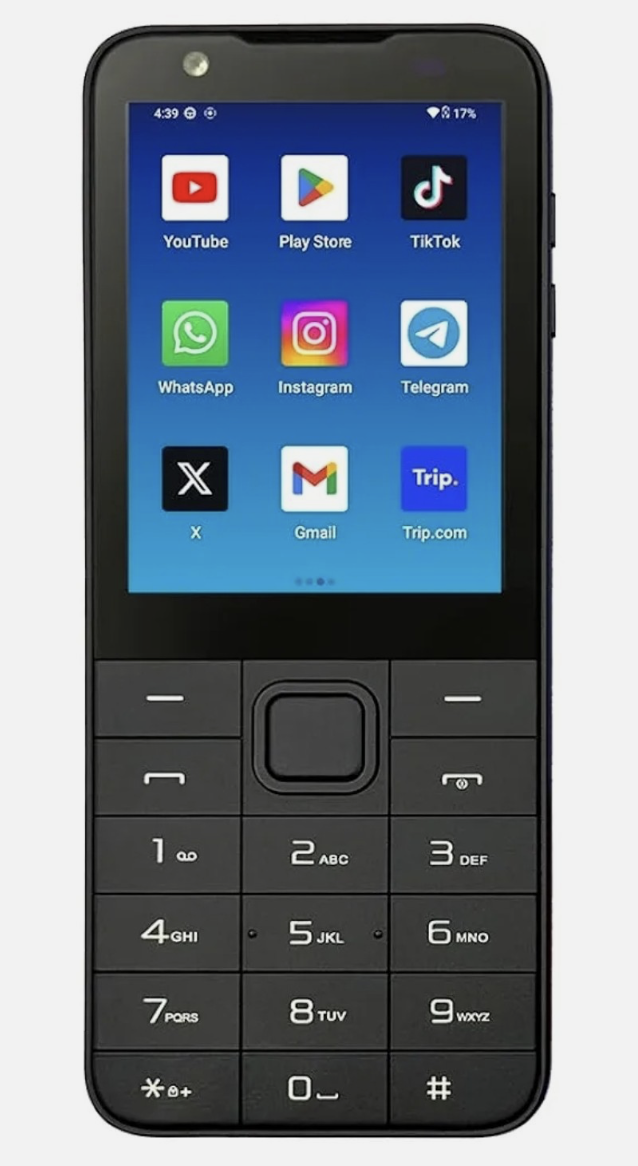 The M5 Mini is indeed a full-featured smartphone running Android, which I actually prefer to the well-dressed bully that is iOS. And along with the physical buttons it has a touch screen and supports voice-to-text, which is really the only way to do anything on this phone.
The thing is though, that screen. It’s tiny. It has terrible colors and a slow refresh rate. It really doesn’t draw you in. It was exactly what I was looking for.
It is a very mediocre piece of hardware. Slow, laggy, takes almost 5 minutes to boot up, don’t even think about multi-tasking. Unappealing and just barely able to get the job done, but priced accordingly. This is what you want to reset your brain. The friction wears down those pleasure receptors quickly.
The first few weeks I would impulsively reach for this silly little phone only to think “what am I going to do with that?” This was exactly what I was hoping to fix - the habitual reach. It was also a great conversation starter. Millennials were nostalgic; other dads at the park would rush over to ask me about it. Gen Zs were curious and slightly horrified. The physical buttons were a wonder to them. I showed some of my students how I could text with T9 and broke their brains. I felt like Jed Clampett.
I used this little guy for about six months. Then I dropped it in the toilet. It dried out and seems to still work, but while it was in the rice I switched back to the iPhone. And guess what? I’m ok. In fact, now that my itchy trigger finger was reformed, the iPhone helped me be on the phone even less since it was good at doing the few things I wanted it to do. No black and white screen, no parental controls, just fixing my own broken default attention.
Here is my five step guide to spending less time on your phone:
The M5 Mini is indeed a full-featured smartphone running Android, which I actually prefer to the well-dressed bully that is iOS. And along with the physical buttons it has a touch screen and supports voice-to-text, which is really the only way to do anything on this phone.
The thing is though, that screen. It’s tiny. It has terrible colors and a slow refresh rate. It really doesn’t draw you in. It was exactly what I was looking for.
It is a very mediocre piece of hardware. Slow, laggy, takes almost 5 minutes to boot up, don’t even think about multi-tasking. Unappealing and just barely able to get the job done, but priced accordingly. This is what you want to reset your brain. The friction wears down those pleasure receptors quickly.
The first few weeks I would impulsively reach for this silly little phone only to think “what am I going to do with that?” This was exactly what I was hoping to fix - the habitual reach. It was also a great conversation starter. Millennials were nostalgic; other dads at the park would rush over to ask me about it. Gen Zs were curious and slightly horrified. The physical buttons were a wonder to them. I showed some of my students how I could text with T9 and broke their brains. I felt like Jed Clampett.
I used this little guy for about six months. Then I dropped it in the toilet. It dried out and seems to still work, but while it was in the rice I switched back to the iPhone. And guess what? I’m ok. In fact, now that my itchy trigger finger was reformed, the iPhone helped me be on the phone even less since it was good at doing the few things I wanted it to do. No black and white screen, no parental controls, just fixing my own broken default attention.
Here is my five step guide to spending less time on your phone: