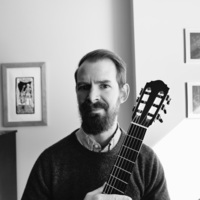
At the end of every school year I send my students this letter. I thought I would share it hear as well. It’s the closest thing I have to a personal manifesto for how I try to go about my life in music.
My dear students,
As you pack up and travel home for the summer I have one final word for you. It concerns the economy.
When I say economy you start thinking about money and budgets and inflation (and this year, tariffs!). That is the money economy. It’s important and affects us all, and music fits into it in a certain way. For those of us that make (or plan to make) a living in music this is very important. You need to know how much money a gig should pay, how may gigs a month will pay the rent, what to charge for a private lesson, and how much self-employment tax you’ll pay on that lesson and those gigs. All of these are important.
But there is another economy that is vital to understand if you are going to make a fulfilling life in music, or really anything else. The economy of gifts.
We rarely think about it, but we live constantly in an economy of giving and receiving gifts. Most of these come in the form of small services we do for one another without expectation of payment. This includes listening, helping, loaning a pencil or sheet of staff paper, sharing a snack, and many of the other ways we interact with one another. Occasionally we exchange physical goods casually and sometimes as formal gifts wrapped up in paper, but the principle is the same: people are more valuable than money.
Whatever the form of a gift, it has a profound advantage over exchanges in the money economy. Nearly everything you buy instantly becomes less valuable. A $100 pair of shoes might be worth $60 after being worn once. Wear them ten times and they’re worth $30 of $40. In the money economy this is called depreciation.
The moment something is given as a gift, however, its value increases. You probably have something you brought to school for your dorm room that is worth very little money, but it’s invaluable to you because someone gave it to you. I have a small pocketknife my grandfather gave me before he died. I could get another one on ebay for $15, but I wouldn’t sell mine for $15,000. This is the power of a gift: it multiplies value with no limit.
And finally, back to music. Though it touches the money economy, I would propose to you that the way to find joy in music is to spend it in the gift economy. This doesn’t mean you don’t take payment for playing, please do. But whether it’s a gig that pays $100 or $1000, the moment you are on stage ready to play the first note, none of that matters. What matters is the giving of the gift we have received and the multiplication of its value by sharing with all who will receive.
There is music that only you can make and you must be willing to give it to us for the world to be as full and rich and beautiful as it is meant to be. This is the power of music. You can give it away without losing anything.
I hope you have a wonderful summer.