Posts in "Music"

On Thinking By Ear

“Words and numbers have unchallenged cultural hegemony. It is our job to promote the importance of sounds!”

This was the battle cry of Vern Falby, one of the teachers I encountered in grad school that had a profound influence on my musical thinking. All of his theory classes were called “Thinking By Ear” followed by whatever the topic of the class actually was. They were very untraditional classes. The text was created by him and mostly consisted of work scores annotated with various “discovery procedures” that he invented to “suss out” (a favorite phrase of his) the inner workings of the piece. After doing many practice scores we would make Shenkerian reduction scores without using the notation. We would listen and sing the middle-ground lines to understand the melodic structure under the surface notes. This was one of only two times in 10 years of collegiate study I was asked to analyze music by ear. (The other was self-imposed because I wanted to write about a piece that did not have a score available).

His approach was his own, and required significant buy-in of time. Results varied for students. For me though, it worked, and it changed how I thought about many things. It was the first time I was truly challenged to do my analysis by ear and parse a form without consulting a score (we once spent several weeks of class listening to the first moment of Mozart’s 23rd piano concerto because someone asked a question about double-exposition form and he had never done one in class before. I have still never looked at a score but I know the form like the back of my hand). He had no interest in observations from the score that we could not actually hear when listening to the piece.

I bring this up because I have encountered an attitude among my students that the score is necessary for a deep understanding of classical music. I think this reveals two things: the kinds of training they have received and the quality of listening they are doing.

There is a historic connection between the growth of literacy and diminishing of memory. It was expected that by age 8 to 10 a young boy in the early medieval era would be “psaltered,” that is, would have memorized the 150 Psalms. It was not unusual for a poet to be able to reproduce an epic of several thousand lines after a single hearing. Even if these individuals were able to read, most things could not be read either because they were not written down or access to written works was so difficult. The only option to store information was in the memory, so it stayed in tip-top shape. (Another topic for another day is the techniques of memory that we have lost.)

Musical memory is no exception. I have played with folk and jazz musicians who can absorb a song in one hearing (including 32 bar changes, which is quite a feat). Most classical musicians I know cannot do this. It takes them many times around before a melody really sticks, much less harmony and all the other information needed.

I am a heavily notation-reliant musician, but in genres where it makes sense I have moved toward working by ear as much as possible. The side effects are surprising. For one, if I learn a song by ear I don’t forget it. There are standards I figured out years ago and can still easily sit down with a guitar to play through. There are other standards I have looked up in the Real Book to play, and I couldn’t even begin to play them without looking again. A favorite phrase of one of my guitar teachers, Christopher Berg, is “recall is more powerful than review.” This is an essential learning principle. You have to make your brain do the work of remembering something or it won’t (anyone remember any phone numbers anymore?). Recall is a muscle in extreme atrophy because of the access to information we are never without.

It seems to me that we should be doing as much listening as score watching in our classes. I think we are perhaps reluctant because working on paper feels legitimizing in the academic setting. When STEM majors are doing advanced calculations and practicing surgery on robotic patients we can’t just sit in class and listen to music, can we? We can, and we should. Analytical listening is exactly the skill we should be building. We might assume our students are doing it, but I wasn’t and I doubt today’s students are either.
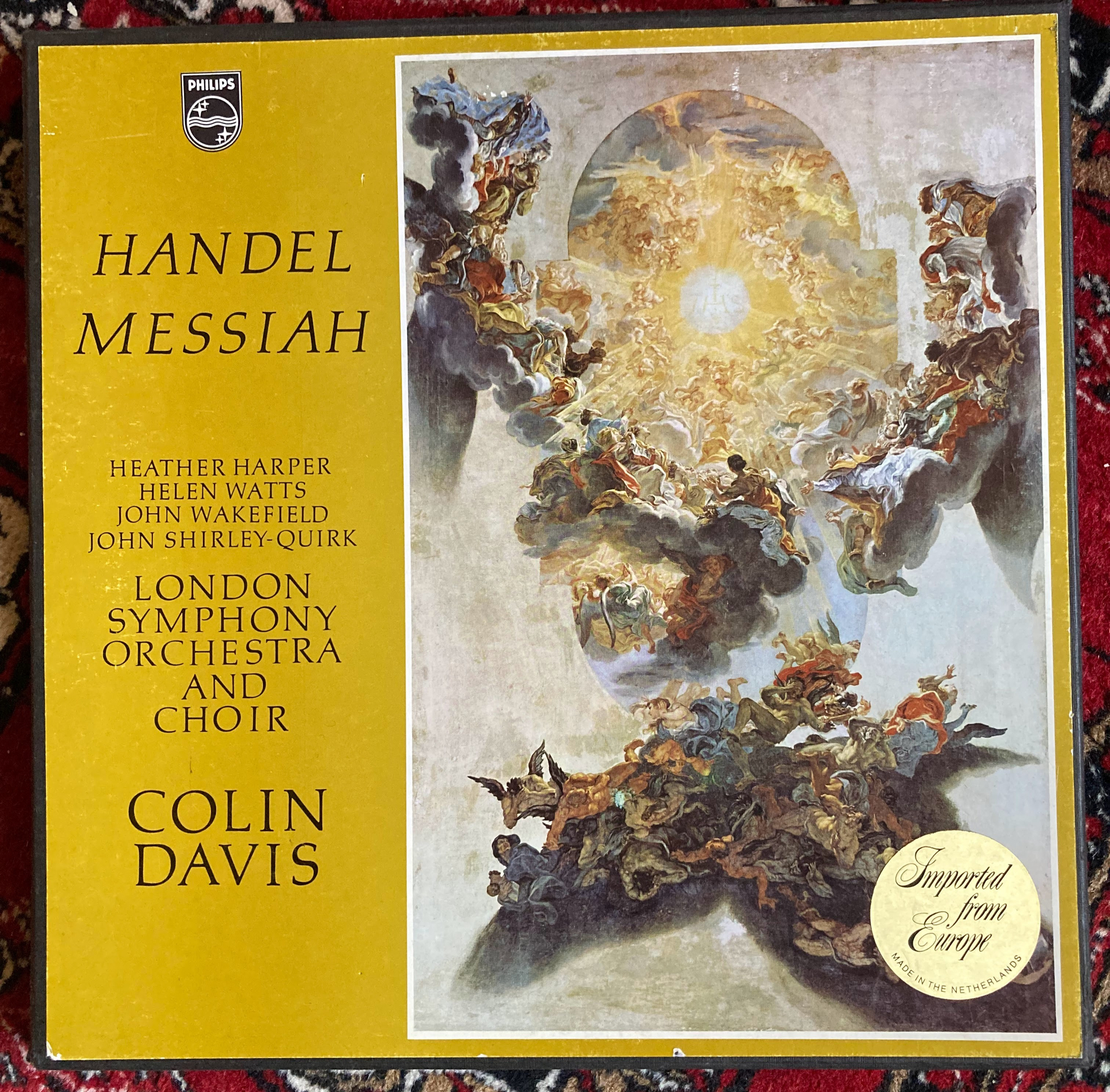
Review: Messiah, London Symphony Orchestra, Colin Davis (1966)

That’s right, it’s Christmas break and we’re reviewing sixty year old recordings.

When it comes to baroque music, I’ve usually been a fan of small ball. Bach cantatas with a chorus of 16 is usually right, and a nimble chamber orchestra is all they need. The music is acrobatic and large ensembles often can’t maneuver at the pace needed.

The same goes for Handel’s Messiah. The recording I have listened to the most is the Academy of Ancient Music directed by Christopher Hogwood. Another particular favorite is Stephen Cleobury’s, which takes all of part I like it’s single breath. Really thrilling pacing.

This year though, I decided to listen through the 1966 London Symphony recording directed by Colin Davis. I’ve had it on vinyl for years (before I had a record player I think, a thrift store find) but realized I’d never actually listened to it. I expected not to like it very much, since it is firmly from the “Big Bach” era of baroque recordings with romantic sized orchestras.

I was wrong, it is wonderful. Though skeptical, I was won over by the end of the Sinfonia. The opening section seemed lethargic to my tastes (24 violins can’t be quite as overdotted as 3), but the heft it gives to the fugatta section was striking. This was the impression throughout, bigger bigs but still small smalls. This group can get to real size without straining.

The tempos are not ponderous, even though the forces are large. The chorus is also quite nimble. It’s hard to imagine the Berlin Philharmonic chorus of the same era handling the choral fugues with the clarity achieved here, but the English choral tradition of a straighter tone and precise tuning really helps.

John Shirley-Quirk is another highlight. His musicianship is unmatched, and his sense of sung English (highlighted in his work with Britten’s operas) is magnificent. The rest of the soloists I could take or leave, Wakefield particularly is the wrong fach.

You may have attended a performance of Messiah that ended with the Hallelujah Chorus. I have. And I would like to apologize for the artistic crime committed against you. The Hallelujah Chorus is a little mid-concert diversion compared to the real ending (and highlight) of Messiah: “Worthy is the Lamb who was slain.”

This is not just the highlight of the work, in context it is the greatest thirty seconds of music in the Western canon. The most perfect unity of form and content ever achieved (despite what Kierkegaard might say about Don Giovanni, music is primarily transcendent, not erotic). When I have sung in the chorus I usually haven’t gotten a single note past the lump in my throat from this point on. Sorry, fellow tenor 2s.

Davis delivers this through the Amens perfectly. Just the right pacing and weight, and truly shimmering violins on the instrument fugue that interrupts the amens before the final chorus.

Davis has another recording of this work with LSO from 2006. Perhaps that will be next.

Thought I’d try out the new video feature with a little piece that is almost exactly 60 seconds long.

Prelude by John Dowland (c. 1563-1626). Google overview says he was born on January 2, 1563, but even the year is somewhat up for debate and no specific date is known.

🎵

What a Concert is For

Two recent concert experiences left me feeling particularly full. Though utterly different music from one another, they had a quality that made me (as someone who gives concerts occasionally) think a little more about what a concert is for. The value of live music has always been self-evident to me, but I think I have placed my finger more precisely on why.

Both recent concerts were joyful affairs with energetic music, but generally speaking my own tastes are more austere. I enjoy music like a winter landscape; beautiful, but also harsh and perhaps even threatening. Not necessarily comfortable, though I make room for that as well.

This is all to say, I have felt the same value at lots of different kinds of concerts and the diversity of the recent two reminded me of the many diverse and profound concert experiences I have been able to have. What is it that they all have in common? Why should we insist that attending live music is such a significant part of the humanities education we offer?

My new thesis is that a concert is an affirmation of the goodness of being alive.

But not just the nice parts of being alive. Music affirms the entire range of the givenness of human experience. A problem the philosophers of music have puzzled over for some time is why people enjoy music expressive of negative emotions. We generally avoid sadness and disappointment if we can, it goes, so why should a concert hall fill to see Dido and Aeneas cruelly separated from one another in the underworld? Why listen to Shostakovich’s tenth symphony roil with anger and bitterness?

Though we instinctively avoid the circumstances that lead to those affects, they are an unavoidable part of life. They are (please forgive me) the being of being a being. Life comes with joys and sorrows. These are given as well, some of the gifts of living.

For some of us it is hard to dwell in our emotions. Weddings and funerals (to span the range of social expression) both have a certain number of ceremonial aspects to slow down and facilitate the feelings we should have at such significant moments. Reflecting on our grandfather’s funeral my brother said, “That was one of the best days of my life.” I completely agreed, but it wasn’t until later I figured out why. In facing up to death and remembering a good life we felt so alive.

This is the role of the concert. It is a place to confront your most uncomfortable feelings, experience them in your body and remember, “This is part of being alive. This is good.”

The performer takes the responsibility of choosing some of the various shades of experience and inviting the audience into them. Our greatest performers are like priests of our emotion, ushering us to a space of deep presence with our inner selves.

When you play the searing D minor partita Sarabande (BWV 1004) you say that living people experience embodied sorrow. (JSB certainly did.)

When the subjects unite in the Jupiter symphony finale you say it is good to live together in diverse unity.

When “Freude” erupts from the chorus of Beethoven’s 9th symphony we say living humans experience unspeakable joy.

The concert is a sacred space to claim some small fragment of the human experience and invite your audience to feel it with you and to remember the gift it is. To live as embodied creatures in a state of reflection so that when we step back out to our living we don’t forget to be alive.

The Birth of a Concert Program

One of my favorite things to do is plan concert programs. As much fun as actually playing concerts is, I am almost constantly thinking up new combinations of pieces that have connections or fit a theme. (If any classical guitarists out there just can’t decide what to play hit me up, I have enough programs for years of my own playing). In an average classical guitar concert, most people will be hearing most of the works for the first time. Presenting them in a context that helps them connect to the music on first hearing and connect them to something they already know is what I’m always trying to do.

Usually I’m working on these programs for a long time, noticing a connection here or there and finding pieces that fit. Once I had the idea to play the Bach D Minor Partita (BWV 1004) but pair each movement with a modern piece that has some resonance with it. It took over a year to choose all the pieces. This past spring, though, I had a program fall from the sky; a bit of curatorial spontaneous generation.

I was driving to work listening to a great album by Alvaro Pierri (https://outhere-music.com/en/albums/brouwer-el-decameron-negro-other-guitar-works) which introduced me to Tres Danzas Concertantes. It’s a work of juvenilia, but packs a serious punch. I knew right away I wanted to play it at some point, and by the time I had gotten to work a full program of guitar and keyboard works had come together.

I wrote it up, emailed it to a colleague and asked if he would be interested in presenting it. He finally agreed and here we are presenting this program.


Manuel Ponce, Sonata for Guitar and Harpsichord

This is a somewhat neglected gem from one of Mexico’s finest composers. Classical in form, baroque in texture and melodic sensibility, and modern in its jarring, nearly constant key changes.

Mario Castelnuovo-Tedesco, Fantasia, Op. 145

This is like the perfect blend of Debussy and da Falla. Lush harmony contrasted with driving rhythm and a remarkable pianism (Tedesco’s own instrument). One of my favorite pieces in all the guitar chamber repertoire. Tedesco lived quite an interesting life and ended up in Las Angeles (like Arnold Schoenberg) teaching composition to aspiring film composers in Hollywood. A wildly prolific composer he wrote over three hundred concert works and about a hundred film scores.

Bryan Kelly, Basque Suite for Guitar and Harpsichord

Kelly is rarely played outside of England. I can find no information about this work other than that it was published in 1978. I only know of it because a copy of the guitar part was included in a box of music given to me by a retiring guitar teacher. A work for guitar and harpsichord seemed unusual (the Ponce being the only I knew of) so I filed it away until the right time, which came with this program.

Leo Brouwer, Tres Danzas Concertantes

The piece that brought all the following three together into one program. I didn’t know until recently that he wrote it when he was only 19. He ability with form is already on display, and it’s really terrific fun.

Glowing Encounters with the Past

I am not one to get much from the lyrics of songs. When musical processes are happening language ones aren’t. There are songs I have listened to hundreds of times and I don’t have the slightest idea what the lyrics are about or even what they are for the most part, it’s just part of the music. I am amazed when I meet people who think of songs as a poem with musical accompaniment. I do not understand that.

This is why it’s surprising that some of the words I’ve thought about the most recently are from a song. In the narrative song “Tangled up in Blue” Bob Dylan presents this scene after the protagonist heads home with a strange woman:

She took down a book of poems and I began to read Written by an Italian poet of the 13th century And every one of them words rang true And glowed like burning coal Pouring off of every page like it was written in my soul From me to you Tangled up in blue.

True to form, this is the only part of the extensive lyrics that I know or understand. This stanza stuck in my mind after a few listens and has been with me ever since. They describe so perfectly an experience of encountering the past that has happened to me and still happens on occasion. It’s something I am almost constantly seeking, though I never thought of it before.

It’s when you are reading an old book, or walking through the 17th century wing of an art museum, and among all the other portraits and lines one arrests you. It speaks directly to you, and you wonder how it came alive. Why does it glow brighter than the rest?

I am a haphazard reader of poetry at best, but I made my way through an entire volume of George Herbert a few years ago. I could read for days without this encounter, then one day, unexpectedly, a poem would grab me by the throat.

Most of my encounters with the past have been through music, but in two different ways. The interpretive work of another musician will show you something you never heard before. What a great gift, to be able to quicken a dead page of notes in the ears of another. But sometimes, when I work hard at it or sometimes at random, it will happen through the musical score.

I’ve been reflecting a lot recently on being an ear-driven musician. A musical score is a curious thing. In many disciplines the cultural artifact is received as it is. We have a painting, a chair, a sculpture. It inhabits its own space and is its very self. The work surrounding it is curatorial (putting it in a context to be appreciated) and critical, commenting on it in relation to itself, it’s contemporaries, and it’s cultural tradition. Other than restorative work, you don’t do much with the thing itself besides careful observation.

Music (in notated form) and drama require realization. The received artifact is a set of instructions, not the thing itself. To be of any interest, this must be done interpretively.

In his musings of the enduring quality of Bach the pianist Jeremy Denk says this about the musical score:

“A score has nothing to do with paper, or e-ink; it can appear on an iPad or on parchment. A score is at once a book and a book waiting to be written. Perhaps a golden age of music was born with the score and died with the recording. If you are listening to a recording, you are hearing someone’s truth about Bach’s truth, their idea of Bach’s truth. The wonderment is that you may hear truths you never suspected, possibilities you never dreamed—but still you are buying another person’s truth. So I say, in all seriousness, if you don’t play an instrument, take one up; take lessons; make the time.”

Embedded here is the idea that the fullest enjoyment of music is through individual interpretation. Making the music as it if were written on your soul and writing it on your own soul in the process.

This is why I continue to play old music. It’s also the standard I bring to old music. If it doesn’t burn and I can’t make it pour off the page like it’s my own then perhaps it should stay in the past. It at least doesn’t belong in my repertoire.

Of all the old music this comes easiest with Bach. Just below the surface it is ready for a renewal. I have been playing the D Minor violin partita (BWV 1004) for almost four years solid now. I cannot imagine getting bored with it. Just today I thought of something new in the minor arpeggio section of the Chaconne. This happens regularly after hundreds of hours of study and practice. This music is like a campfire ember clouded over with ash; the slightest stir will renew its glow.

We don’t always know what’s written on our souls. We’re like Sauron’s ring of power. It has a message but it’s faded from view until it’s been put in the fire so it can glow again. It’s not always obvious when a piece of music will come to life either. Some require a lot of work. The spark isn’t easy to find. Sometimes an inspiration I’ve heard in another performer seems flat and lifeless in my hands. But when the combination of text and performance come together, an old Italian from the 13th century might show you something you needed to say and give you the words to say it.