Posts in "Music"

Matters of Interpretation

Following up from yesterday’s post about interpretation: I taught on the subject in a recent class. I gave a few examples, one musical and one dramatic, to demonstrate what we (the interpreter) bring to the texts we present in performance.

The first was maybe obvious, but makes the point exceedingly well. Glenn Gould playing Variation I from the Goldberg Variations (1955 recording) and Glenn Gould playing Variation I from the Goldberg Variations (1981 recording).

1955:

1981:

One student didn’t even pick up that these were the same pieces (she admitted she was distracted by what she thought was a typo on the slides when I put the same performer and piece information up twice). Other students chuckled or nodded knowingly as I started the second recording. Such wildly different readings by the same person. We discussed what the elder Gould was attempting to show about the music that young Gould was not, and vice versa. As we listened a bit more, it seemed that students started to come around to the 1981 when they initially thought it was a bit goofy. (Gratifying, I’m a pretty devout 1981 recording fan).

The point is: they are wildly different and everything that sounds differently is a matter of interpretation.

My second example is a bit different. I used Speechify to create a reading of To be, or not to be. I used the “British English - dramatic” voice. Here’s how it sounds:

I’ll be honest, it’s better than I expected it to be. (And significantly better than it was in the first version of this lecture I prepared two years ago). It observes punctuation, leaves space, and has a pretty convincing cadence. It is, in other words, correct. Though it pains me to say, it’s as good or better than many actors I’ve heard on the stage. But it isn’t interpretive.

We then listened to the Andrew Scott version:

Let’s just say, the hush in the room made it clear the point was thoroughly made.

Literacy, Improvisation, & Interpretation

A year or two ago I read an old scholarly book that (while certainly past its prime) gave me some interesting things to think about in relation to music. As a teacher of ear training, I’m fascinated the effect musical literacy (both learning music from scores, and the culture surrounding notated music) has on our conception of music, how we listen to it, how we learn it, and how we remember it.

Walter Ong’s Orality and LIteracy: The Technology of the Word, is a classic text that summarizes the developments orality studies made in the 20th century (published in 1982, most of his sources were written from 1960 on after significant field research occurred in the first half of the century). Ong cites studies on Yugoslavian epic poets who very purposefully avoided learning to read because they instinctively knew that it would diminish their memory and ability to perform their poems.

According to Ong though, large-scale epic poetry is decidedly not memorized verbatim. The oral poet is employing a very different process than the English school boy compelled to recite Lord Byron line by line (if they still do this, it’s been a while since Goodbye, Mr. Chips I suppose). The oral poets internalize the shape of the story, and employ a vast library of tropes and set pieces to convey it, in effect making the story in each telling. The set pieces are in the correct meter, and they have collections of phrases that will complete a line when needed to maintain the metrical feel. They have a functional library of poetic devices and phrases that are extemporized in new combinations for each telling.

When asked, the poets themselves say that they tell the stories “the same way” each time, though comparing recordings of different events shows there are often significant differences. The concept of a “verbatim” retelling is foreign to a mind that does not interact with texts in their rigid fixity. They do indeed use the same lines to tell the same story, which is what they mean when they insist that each performance is the same, but the particular order and combination of lines varies from performance to performance. Oral recitation is a social interaction between audience and speaker. The environment and give-and-take shape how the story is told in each instance.

That is to say, the poets are playing jazz.

A tune from The Real Book has a general melody, chord progression, and structure (although the classically trained students in my improvisation class found it very difficult to grasp a lot of standard melodies since the performers ornament them so much). Each realization of it, however, is unique because solos are improvised, and comping is a subtle art of reacting to the soloist. In my (very limited) experience of playing standards, the better I know the song, the more differently I will play it each time. If I know the changes well enough to inhabit them there is greater freedom of exploration and creativity rather than just trying to remember what comes next. Add an audience to the mix, and there is a matrix of influences that combine to create that one moment of musical time, never to be repeated. But of course it was just Autumn Leaves. Saying we played Autumn Leaves though is such a different thing than saying I performed the D Minor Partita by Bach. This is why “music” is such a difficult thing to talk about, it comes in so many forms and practices.

This experience of spontaneous creativity is the most compelling aspect of improvisation. Christopher Berg (my wonderful undergrad teacher) spoke of classical performance as a “rehearsed improvisation.” He loved the experience of being on stage and being able to incorporate fresh ideas into the performance. A good concert hall filled with an attentive audience is an inspiring thing. The ability to respond to that can breathe life into a performance. And it should! The connection with the audience is the point of the whole thing.

Improvisation has been systematically eliminated from the education of classical musicians. Until somewhat recently every musician was also a composer and improviser. It was just part of their training. Philip Glass describes one of Nadia Boulanger’s part-writing exercises in Words Without Music. Three students would participate. M. Boulanger would play a melody. The first student would sing a bass line that followed all part-writing rules against the melody (from memory and by ear, mind you). The second would sing a tenor line that accompanied both soprano and bass. The third would have to remember each line and supply an alto line that would not conflict with any of the extemporized parts. This is striking (and a story worth telling in a memoir) because it is so unusual in 20th century theory pedagogy.

Concerto cadenzas originated as a fermata left by the composer to indicate that is where the soloist would improvise (or compose) their own cadenza. Now in those concertos without composer-supplied cadenzas there are “traditional” cadenzas written by someone else and codified into the score, given a shelf in what Nicholas Cook calls the “musical museum”.

The cult of genius is at least partly to blame here. Since Beethoven and the Romantic era there has been an elevation of the few “geniuses” whose muse could break through everyday composition and give us these special musical revelations that deserve being enshrined in the canon forever. (Despite the fact that there is significant unevenness of quality in that canon). Why would I piddle around with improvising (much less composing) when I could be learning Beethoven instead?

The performer in this framework is essentially a messenger, delivering, intact, the vision of someone else. To borrow from Nicholas Cook again, classical musicians don’t give us their own music, it is a “performance of” the piece. Did you hear Barenboim’s performance of the Beethoven Sonatas? Barenboim has nothing to say, except as an authoritative channel for Beethoven’s genius.

For orchestral players (highly trained, sensitive artists in their own right) the situation is even worse. Not only are they serfs to the Great Composers, they must deliver them according to the desires of the conductor who, if he is established enough (and it is generally he), is heralded a sub-genius who has seen through the fog to the true inspiration within the music handed down from the first-level genius whose golden pen delivered these notes to us.

This is why so much of our classical musical training is spent ensuring accurate execution of the written score. Now, I appreciate a nice clean performance as much as the next person (probably a lot more actually), but if that is all you do it really stunts your creativity. The closely controlled structures of classical music provide a wonderful framework for creativity. When you know your way through a piece the interpretive decisions made in a compelling performance can be bracing. To do this though, you must get past the realm of notes and into the world of sound. This is what I want my students to do, see through the score to a world of imaginative hearing and listening where we can find “what the sound wants to do,” to quote my other great teacher (Julian Gray).

If there is a genius to works in the canon (skeptical though I am of the concept, I am fairly dedicated to much of the canonical repertoire), it is in how they can be interpreted and delivered in a meaningful way. This role of interpretation must be held up as the highest form of musical achievement for classical musicians, much like the great masters of jazz are the improvisers.

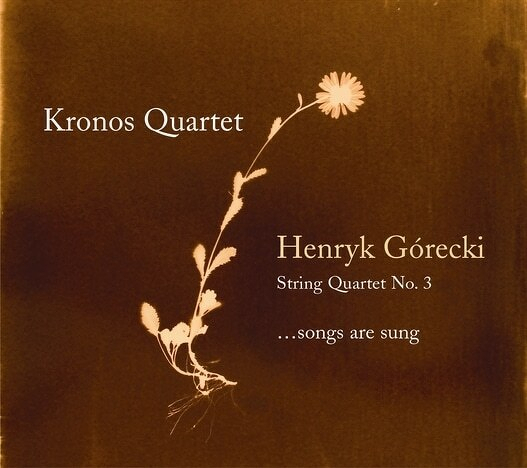
Music That Made Me: Gorecki String Quartet No. 3

After the explanation and introduction, on to the albums:

The influence my older brothers had (I have three of them 4-, 11-, and 15-years older) on my musical tastes cannot be overstated (we did our best on the youngest but I understand he mostly listens to lo-fi beats and dubstep [this is a joke {mostly}]). What thirteen-year-old is banging away to Philip Glass’s North Star or sitting through the long version of Gavin Bryars’s Jesus Blood Never Failed Me Yet? You don’t find these things on your own, especially when you don’t have internet access and you’re still looking for Great Illustrated Classics on visits to the library.

A lesson I learned from them early on is that interesting music tends to be found in a few reliable places. Nonesuch, ECM New Series, Argo, and Bis were the labels to look for. Another of these trusted sources is the Kronos Quartet. A Kronos record will always be interesting, some will change your life.

Much of the great quartet music of the last fifty years is thanks to their commissioning work, and the three string quartets of the Polish composer Henryk Gorecki are no exception. Of the many Kronos recordings I adore, String Quartet No.3 “…songs are sung” is probably my favorite. I listened to over and over again after it was released in 2005.

Gorecki’s career follows a trajectory somewhat common for composers born in the early 20th century. An upbringing in formal music education meant an expectation of learning and composing serialism. Once established he turned toward a quasi-tonal style influenced by pre-classical music. This later style (and his return to writing liturgical works) means he is often compared to Arvo Pärt and John Tavener, but his style is his own.

Though his career follows a familiar trajectory, it has one unusual characteristic: a massive hit recording with his Symphony No. 3. It has sold over a million copies, a ridiculous number for a contemporary classical CD. Remarkably, his composing style does not seem to have responded to fame and that remains his only widely known work. (My own first encounter with Symphony 3 work was on a trip to Phoenix of all places. I bought a used copy in a book & record shop. Back at the hotel that night I synced it to my iPod and listened to it straight through lying on the floor of the hotel room while everyone else was asleep).

All three quartets are works of melancholy, and even anguish, but very different projects structurally. The first is a single long movement following the model of Shostakovich’s 13th. The second is a four movement classical quartet in a highly dissonant sonority. The third (Op. 69) is on a massive scale lasting almost 50 minutes. Of its five movements only the third is at a faster tempo (and not that fast). The other four are slow, dissonant, mournful but not harsh, and with a distinct progression toward hopefulness in the last two movements.

The quartet (following an innovation of Bartok) is in a symmetrical arch form. Symmetry and balance are the preoccupying structural features. The four slow movements are each almost exactly ten minutes long, with the middle movement lasting five. Each movement has distinct sections that mirror one another. The central movement inverts the form of the work as a whole with a central slower section (introducing some of the first unambiguously major key material) surrounded by the agitated counterpoint of the outer sections. There’s something of a dialectic from minor key dissonance toward major key consonance broken by the activity of this middle movement. This large scale movement continues until the final chords which resolve with a flat 6 suspension reminding us of the minor key beginning of the piece before settling into a long, low-voiced major chord.

Kronos plays with a sustained intensity that never flags but also never overflows the banks of Gorecki’s introspective restraint. They are known for not over-polishing their sound with vibrato, and that effect gives a raw expressiveness to the melodies.

This is decidedly inward-focused music. It is a commitment, but repeated listenings reveal a work of psychological depth. It is one of many expressive touchstones I return to again and again.

If there is one lesson this album taught me, it is that music can go straight to your heart in a way nothing else can. A serious lesson to learn when you’re fourteen.

The Music That Made Me

A project of personal musical formation.

One of the books I’ve most enjoyed reading the last few years was Brad Mehldau’s Formation: Building a Personal Canon Part I (I eagerly await the publication of Part 2). It is a remarkable memoir that weaves together his own life story up through his 20s with the experiences of music that formed him into the musician he is. With incredible forthrightness he chronicles the bullying of his childhood, the sexual assault he experienced at the hands of his high school principal, the many years of coming to grips with this through risky sexual activity, then his descent into a heroin addiction that dominated his 20s. It is not an easy read, but he manages all of this without being prurient or self-pitying.

Throughout he writes beautifully and insightfully about experiencing music from his earliest memories to playing in NYC clubs as an emerging force in the modern jazz scene.

Reading it has helped me reflect on my own musical formation a bit. The most influential forces in my life as a musician have been albums that captured my attention and drew me into their world over and over again, making irresistible the draw to make a life in music. Most of these were recordings, many were scores I played, and a very few were live performances. By far the larger part were recordings. This project is a look back at some of the albums that were most important to me as I grew up.

Part I: Introduction, A Life of Listening

I believe there have been two great historical declensions in Western music: before and after the development of notation and before and after the invention of recording. Of these two, I would argue that recording is a much more impactful invention. If nothing else, it has had a broader impact since it is not just a technology for composers and performers but for everyone who enjoys music.

For someone who grew up relatively far away from the centers of culture, recordings were the key to my musical formation. I started listening to music before the iPod, so CDs were my first way into music. With limited access to the internet (and too many scruples for piracy), a BMG membership was my portal to the world of sound. The hours I spent agonizing over what albums I would choose for my monthly $6.99 cd, or a 12 for $3.99 each deal. The chores I did so that I had the money to spend on these!

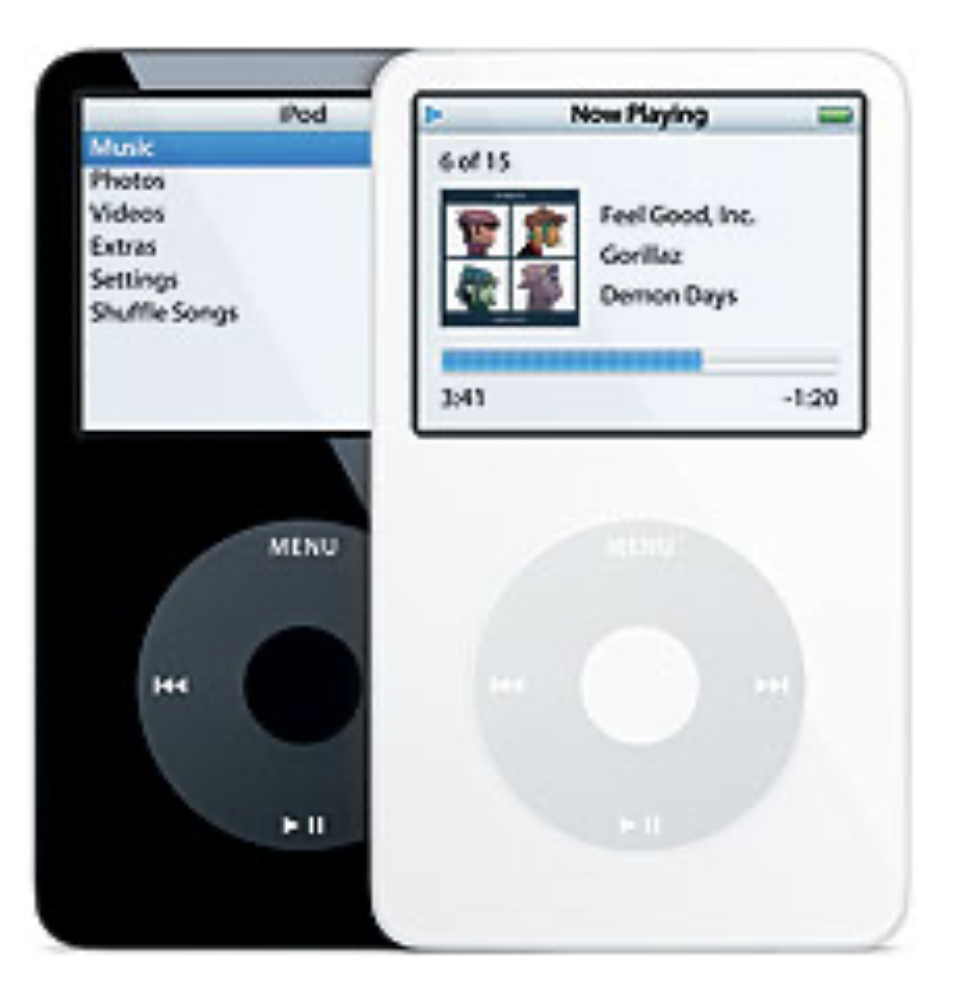
Christmas of 2007 brought me the 30GB iPod Video. This didn’t change my relationship to CDs as much as make them much more portable. From this point on I was listening to music all the time. There is some music I purchased digitally (before the Starbucks gift card was a standard small gift the iTunes gift card was preeminent), but the music I really absorbed almost all came to me on CDs, which I ripped to my computer, organized and labelled (the earliest iTunes couldn’t download track information, you had to sit there with the jewel case or liner notes and type in each track!), and synced to my iPod. This syncing of course required a cord, because the iPod video could not access the internet. This was a ritual of near religious importance to me.

I had it in white. It shipped with the worst headphones ever devised.

In my teenage years I was generally either playing basketball, playing the guitar, or listening to music while doing something else. An enormous advantage of being homeschooled was that I had music going basically all the time while doing schoolwork. It also meant I could do my school work quickly and leave more time for basketball and music. Even with that extra time, I was most often practicing from about 10PM-12 or 1AM. This was partly personal preference and partly that during sports seasons the days were just very full.

This was also before any kind of streaming service was available, so the music you had available to listen to was owned or borrowed. Our tiny public library had a remarkably good selection of contemporary classical records curated by one of the libarians who had very hip tastes (nearly a whole shelf of Argo, Bis, Nonesuch, and ECM New Series recordings). In a full circle moment, a few Christmases ago I was visiting and took my kids to the library to play in the children’s area (it was freezing cold outside). By the entrance was a table of CDs being given away for free. Gavin Bryars, Michael Torke, Alfred Scnittke, many of the same CDs I checked out as a high schooler were there with date stamps in the mid-2000s as the last time they circulated. That is to say, before they became part of my permanent collection I (or one of my brothers) was the last person the check them out.

So whenever the mood strikes me, I’m going to go to my record/CD cabinet and pull out something that was a huge deal to me as a kid and write a bit about it. I don’t have a list, I’m just going to follow my gut and my ear.

It’s a three concert week! Two different programs, but both including this ray of sunshine.

Felicidade, Tom Jobim (Arr. Roland Dyens)

🎵🎸

Academic Sounding Twaddle

In the most recent issue of the Guitar Foundation of America’s Soundboard Magazine (which isn’t available online) there is an article that has some real twaddle in it. The kind of thing that sounds impressive and passes for analytical insight, but is essentially meaningless.

Discussing the different issues surrounding historically informed interpretation of the music of Bach the author states the following:

We cannot fully understand the ideas of Bach or his contemporaries, because we, as modern listeners and performers, operate from a fundamentally different historical vantage point—one shaped by centuries of evolving musical interpretation.

Which is—obvious? How everything in the world works? And presupposes that there is some ultimate understanding of Bach that apparently his contemporaries could understand since they were of the same vantage point. Despite the fact that Bach’s music was generally unliked (even if respected) in his own day and distinctly unfashionable.

Does 200 years of performing, editing, recording, analyzing, and interpreting the music of Bach give us a lesser or greater understanding of the music? It took an interpreter like Pablo Casals to bring the Bach cello suites to broader attention. He quite literally found the music there that everyone else had ignored. Why was he able to do this? Probably because he (as an inheritor of the romantic tradition of interpretation) took it upon himself to interpret the music using his own taste and acculturation as a guide. And he had immaculate taste. Though clearly of their time, his interpretations are still vivid and arresting. The rich product of nearly fifty years of practice, performance, and contemplation.

(An historical sidenote: his first recording session occurred at Abbey Road Studios, a few decades before it would become the recording home of the Beatles. Casals (born in 1876) disliked recording and could only be convinced to do so because his political commitment to democracy and against fascism meant he refused to concertize in his native Spain, Germany, Italy, or Russia, effectively putting his European concert schedule on hold in the 1930s. More notes here. I can’t recommend Paul Elie’s Reinventing Bach enough if this interests you).

Very little scholarship (particularly manuscript scholarship) had been done when Casals discovered the suites in a secondhand store. He developed an interpretation from the version of the score he had, and he found deep riches there. Did Anna Magdalena (Bach’s second wife and the presumed recipient of the suites) understand this music more than Casals? A fascinating and unanswerable question. Her cello playing—like every note of music ever played before recording technology, and the vast majority of them since—is lost to history. There is a very real possibility that Bach would have liked her playing more than Casals, but we would prefer Casals (or Rostropovich or Maisky or Ma or whoever you like). There is very little doubt that our modern masters play at a technical level unthinkable to Bach in his time. (In her defense, A.M. had a lot of kids to raise).

Later in the article he quotes a paper that gives a symbolic analysis of the fugue from BWV 997 (it concerns the elements in the first ten seconds of this recording). According to one person, this music apparently means the following:

  1. Five diatonic notes: symbolic of human perfection
  2. Saltus duriusculus / descending seventh: representing the Fall of Adam
  3. Five chromatic notes [in the higher voice]: signifying pain and suffering after the Fall
  4. Quotation of the chorale theme Nun komm, der Heiden Heiland, evoking the salvific act of Christ
  5. Resolution through a descending fifth: symbolizing Divine Grace [also one of the most formulaic of all cadence gestures]

I haven’t read the paper this comes from so I can’t answer if there is any documentary evidence from Bach that this is the case or if it is just a hunch by the writer. (I’ve read other symbolic analyses like this before and they are usually based on hunches). I’m also not categorically opposed to these kinds of interpretations, as long as they are presented as interpretive and not as an absolute musical truth. Some performers find this kind of representation very helpful. I get a good shiver from a saltus duriusculus just as much as the next guy. But absent some kind of evidence, or the greatest clue of all—lyrics, we can’t read Bach’s mind on what he intended. Especially not down to this level of granular meaning.

The author of the article can’t take that reasonable approach though. He comments, “for the performer, awareness of these rhetorical and symbolic dimensions is essential to an expressive and historically informed interpretation.”

This is so obviously not true I’m amazed it passed editorial. I’ve played this piece in utter ignorance of this possible symbolism and I daresay it was expressive. In fact, I wrote a substantial analysis of the form of this piece (it’s a da capo fugue, quite unusual) and brought many insights from that to bear on my performance. Alas, the fact that this all happened before the above was proposed means that my performance was helplessly inexpressive.

On Thinking By Ear

“Words and numbers have unchallenged cultural hegemony. It is our job to promote the importance of sounds!”

This was the battle cry of Vern Falby, one of the teachers I encountered in grad school that had a profound influence on my musical thinking. All of his theory classes were called “Thinking By Ear” followed by whatever the topic of the class actually was. They were very untraditional classes. The text was created by him and mostly consisted of work scores annotated with various “discovery procedures” that he invented to “suss out” (a favorite phrase of his) the inner workings of the piece. After doing many practice scores we would make Shenkerian reduction scores without using the notation. We would listen and sing the middle-ground lines to understand the melodic structure under the surface notes. This was one of only two times in 10 years of collegiate study I was asked to analyze music by ear. (The other was self-imposed because I wanted to write about a piece that did not have a score available).

His approach was his own, and required significant buy-in of time. Results varied for students. For me though, it worked, and it changed how I thought about many things. It was the first time I was truly challenged to do my analysis by ear and parse a form without consulting a score (we once spent several weeks of class listening to the first moment of Mozart’s 23rd piano concerto because someone asked a question about double-exposition form and he had never done one in class before. I have still never looked at a score but I know the form like the back of my hand). He had no interest in observations from the score that we could not actually hear when listening to the piece.

I bring this up because I have encountered an attitude among my students that the score is necessary for a deep understanding of classical music. I think this reveals two things: the kinds of training they have received and the quality of listening they are doing.

There is a historic connection between the growth of literacy and diminishing of memory. It was expected that by age 8 to 10 a young boy in the early medieval era would be “psaltered,” that is, would have memorized the 150 Psalms. It was not unusual for a poet to be able to reproduce an epic of several thousand lines after a single hearing. Even if these individuals were able to read, most things could not be read either because they were not written down or access to written works was so difficult. The only option to store information was in the memory, so it stayed in tip-top shape. (Another topic for another day is the techniques of memory that we have lost.)

Musical memory is no exception. I have played with folk and jazz musicians who can absorb a song in one hearing (including 32 bar changes, which is quite a feat). Most classical musicians I know cannot do this. It takes them many times around before a melody really sticks, much less harmony and all the other information needed.

I am a heavily notation-reliant musician, but in genres where it makes sense I have moved toward working by ear as much as possible. The side effects are surprising. For one, if I learn a song by ear I don’t forget it. There are standards I figured out years ago and can still easily sit down with a guitar to play through. There are other standards I have looked up in the Real Book to play, and I couldn’t even begin to play them without looking again. A favorite phrase of one of my guitar teachers, Christopher Berg, is “recall is more powerful than review.” This is an essential learning principle. You have to make your brain do the work of remembering something or it won’t (anyone remember any phone numbers anymore?). Recall is a muscle in extreme atrophy because of the access to information we are never without.

It seems to me that we should be doing as much listening as score watching in our classes. I think we are perhaps reluctant because working on paper feels legitimizing in the academic setting. When STEM majors are doing advanced calculations and practicing surgery on robotic patients we can’t just sit in class and listen to music, can we? We can, and we should. Analytical listening is exactly the skill we should be building. We might assume our students are doing it, but I wasn’t and I doubt today’s students are either.

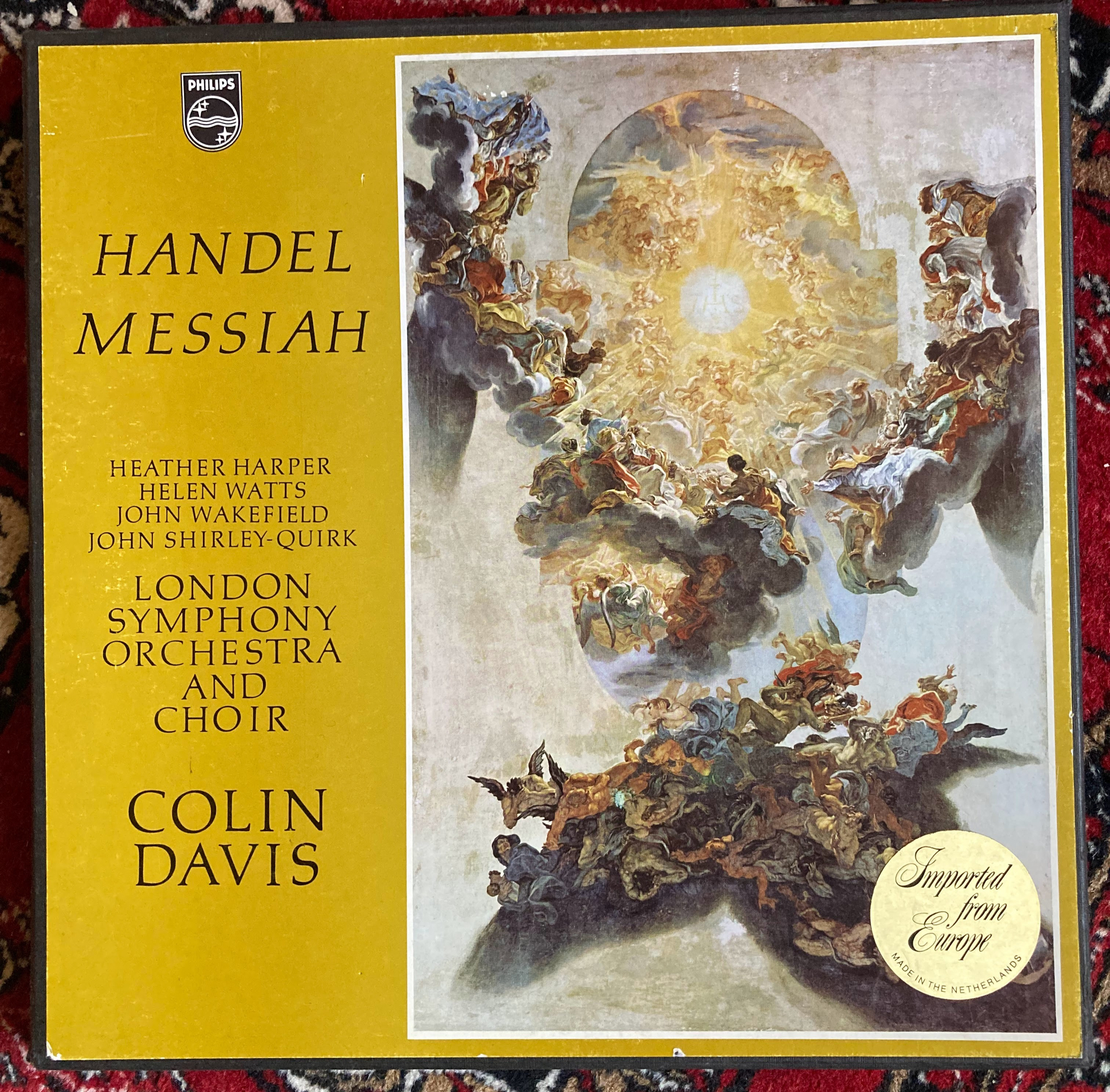
Review: Messiah, London Symphony Orchestra, Colin Davis (1966)

That’s right, it’s Christmas break and we’re reviewing sixty year old recordings.

When it comes to baroque music, I’ve usually been a fan of small ball. Bach cantatas with a chorus of 16 is usually right, and a nimble chamber orchestra is all they need. The music is acrobatic and large ensembles often can’t maneuver at the pace needed.

The same goes for Handel’s Messiah. The recording I have listened to the most is the Academy of Ancient Music directed by Christopher Hogwood. Another particular favorite is Stephen Cleobury’s, which takes all of part I like it’s single breath. Really thrilling pacing.

This year though, I decided to listen through the 1966 London Symphony recording directed by Colin Davis. I’ve had it on vinyl for years (before I had a record player I think, a thrift store find) but realized I’d never actually listened to it. I expected not to like it very much, since it is firmly from the “Big Bach” era of baroque recordings with romantic sized orchestras.

I was wrong, it is wonderful. Though skeptical, I was won over by the end of the Sinfonia. The opening section seemed lethargic to my tastes (24 violins can’t be quite as overdotted as 3), but the heft it gives to the fugatta section was striking. This was the impression throughout, bigger bigs but still small smalls. This group can get to real size without straining.

The tempos are not ponderous, even though the forces are large. The chorus is also quite nimble. It’s hard to imagine the Berlin Philharmonic chorus of the same era handling the choral fugues with the clarity achieved here, but the English choral tradition of a straighter tone and precise tuning really helps.

John Shirley-Quirk is another highlight. His musicianship is unmatched, and his sense of sung English (highlighted in his work with Britten’s operas) is magnificent. The rest of the soloists I could take or leave, Wakefield particularly is the wrong fach.

You may have attended a performance of Messiah that ended with the Hallelujah Chorus. I have. And I would like to apologize for the artistic crime committed against you. The Hallelujah Chorus is a little mid-concert diversion compared to the real ending (and highlight) of Messiah: “Worthy is the Lamb who was slain.”

This is not just the highlight of the work, in context it is the greatest thirty seconds of music in the Western canon. The most perfect unity of form and content ever achieved (despite what Kierkegaard might say about Don Giovanni, music is primarily transcendent, not erotic). When I have sung in the chorus I usually haven’t gotten a single note past the lump in my throat from this point on. Sorry, fellow tenor 2s.

Davis delivers this through the Amens perfectly. Just the right pacing and weight, and truly shimmering violins on the instrument fugue that interrupts the amens before the final chorus.

Davis has another recording of this work with LSO from 2006. Perhaps that will be next.

Thought I’d try out the new video feature with a little piece that is almost exactly 60 seconds long.

Prelude by John Dowland (c. 1563-1626). Google overview says he was born on January 2, 1563, but even the year is somewhat up for debate and no specific date is known.

🎵

What a Concert is For

Two recent concert experiences left me feeling particularly full. Though utterly different music from one another, they had a quality that made me (as someone who gives concerts occasionally) think a little more about what a concert is for. The value of live music has always been self-evident to me, but I think I have placed my finger more precisely on why.

Both recent concerts were joyful affairs with energetic music, but generally speaking my own tastes are more austere. I enjoy music like a winter landscape; beautiful, but also harsh and perhaps even threatening. Not necessarily comfortable, though I make room for that as well.

This is all to say, I have felt the same value at lots of different kinds of concerts and the diversity of the recent two reminded me of the many diverse and profound concert experiences I have been able to have. What is it that they all have in common? Why should we insist that attending live music is such a significant part of the humanities education we offer?

My new thesis is that a concert is an affirmation of the goodness of being alive.

But not just the nice parts of being alive. Music affirms the entire range of the givenness of human experience. A problem the philosophers of music have puzzled over for some time is why people enjoy music expressive of negative emotions. We generally avoid sadness and disappointment if we can, it goes, so why should a concert hall fill to see Dido and Aeneas cruelly separated from one another in the underworld? Why listen to Shostakovich’s tenth symphony roil with anger and bitterness?

Though we instinctively avoid the circumstances that lead to those affects, they are an unavoidable part of life. They are (please forgive me) the being of being a being. Life comes with joys and sorrows. These are given as well, some of the gifts of living.

For some of us it is hard to dwell in our emotions. Weddings and funerals (to span the range of social expression) both have a certain number of ceremonial aspects to slow down and facilitate the feelings we should have at such significant moments. Reflecting on our grandfather’s funeral my brother said, “That was one of the best days of my life.” I completely agreed, but it wasn’t until later I figured out why. In facing up to death and remembering a good life we felt so alive.

This is the role of the concert. It is a place to confront your most uncomfortable feelings, experience them in your body and remember, “This is part of being alive. This is good.”

The performer takes the responsibility of choosing some of the various shades of experience and inviting the audience into them. Our greatest performers are like priests of our emotion, ushering us to a space of deep presence with our inner selves.

When you play the searing D minor partita Sarabande (BWV 1004) you say that living people experience embodied sorrow. (JSB certainly did.)

When the subjects unite in the Jupiter symphony finale you say it is good to live together in diverse unity.

When “Freude” erupts from the chorus of Beethoven’s 9th symphony we say living humans experience unspeakable joy.

The concert is a sacred space to claim some small fragment of the human experience and invite your audience to feel it with you and to remember the gift it is. To live as embodied creatures in a state of reflection so that when we step back out to our living we don’t forget to be alive.